
In short: Data centre commissioning is where the programme is won or lost. Time-to-power is fixed and contractual, the build involves 500+ trades and complex Tier III/IV commissioning sequences, and the margin for slip is close to zero. Hitting the date is not about working harder at the end; it is about reliable short-term planning and treating commissioning as the critical path from the start.
On most construction projects, a few weeks of slippage is absorbed and forgotten. On a data centre, it is a different story. The client has sold capacity against a date. Time-to-power is contractual, often with penalties, and every day the facility is not energised is revenue that does not arrive. That single pressure, a fixed and unforgiving end date, changes how the whole programme has to be run.
This piece looks at why data centre commissioning is so unforgiving, where programmes actually lose time, and what it genuinely takes to coordinate 500+ trades to a fixed time-to-power without slip.
Why data centre commissioning is different
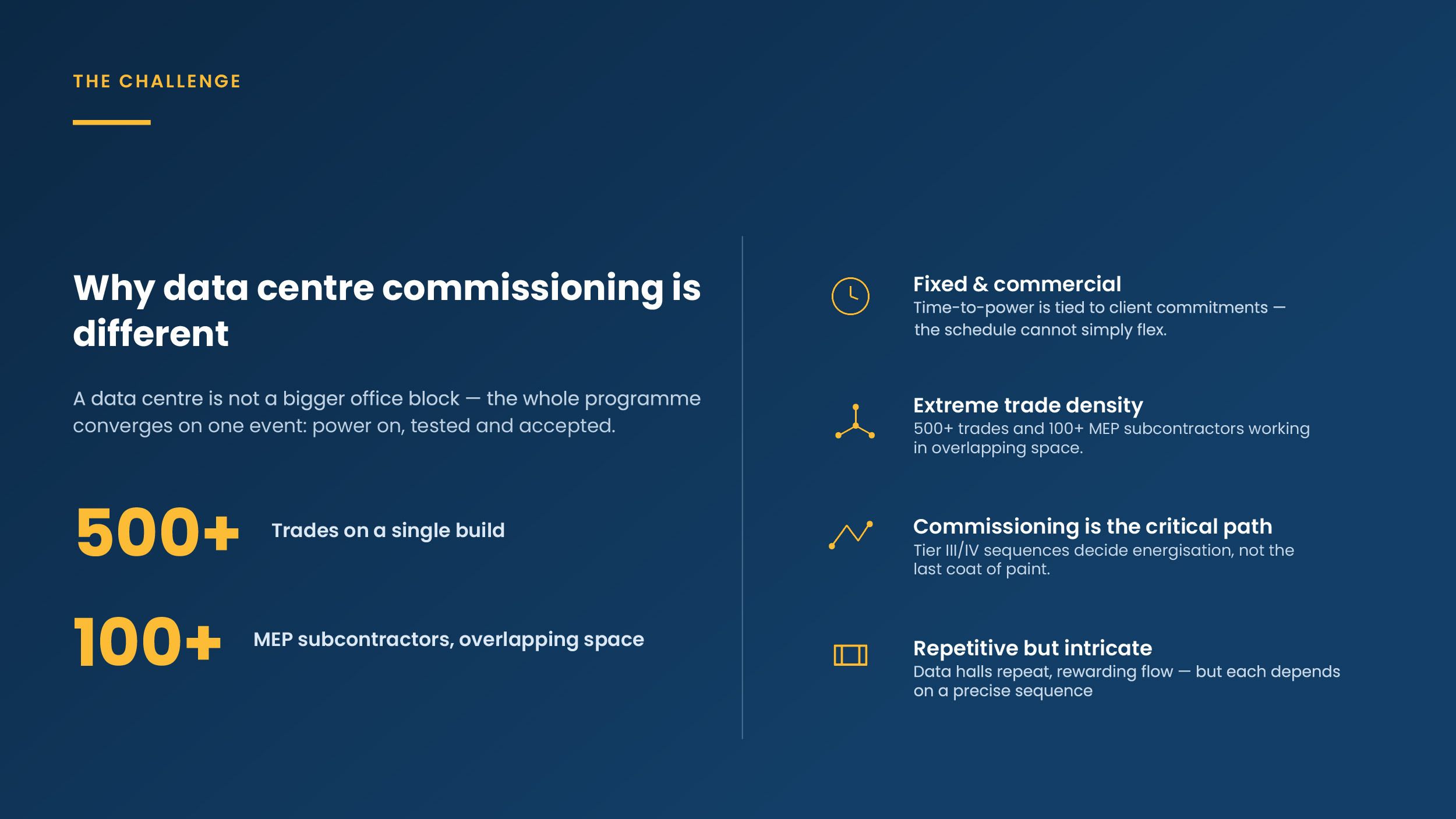
A data centre is not a bigger office block. Hyperscale and colocation builds compress an enormous amount of mechanical, electrical, and plumbing work into a tight envelope and an aggressive schedule, and the whole programme converges on one event: power on, tested and accepted.
- The end date is fixed and commercial. Time-to-power is tied to client commitments, so the schedule cannot simply flex when things go wrong.
- The trade density is extreme. A single build can involve 500+ trades and 100+ MEP subcontractors working in overlapping space.
- Commissioning is the real critical path. Tier III and Tier IV commissioning sequences, not the last coat of paint, decide when the facility can be energised and accepted.
- The work is repetitive but intricate. Data halls and white-space repeat, which rewards production flow, but each depends on a precise sequence of MEP and structural work.
Put together, these mean the usual approach, a top-down Gantt and a push to catch up near the end, does not work. There is no slack to catch up into.
Where data centre programmes lose time
Slip on a data centre rarely comes from one dramatic failure. It accumulates quietly:
- MEP coordination clashes that surface on site rather than in the model.
- Commissioning sequences that cannot start because a prerequisite trade or test is not actually complete.
- Constraints, such as long-lead equipment, power availability, or outstanding design, that were never cleared before work was released.
- A master schedule in P6 or MSP that looks healthy on paper while the site tells a different story, with the drift only visible in the weekly report, by which point it is already too late to recover cheaply.
Each of these is a flow problem, not an effort problem. The crews are working; the sequence is failing around them.
What "zero slip" actually requires
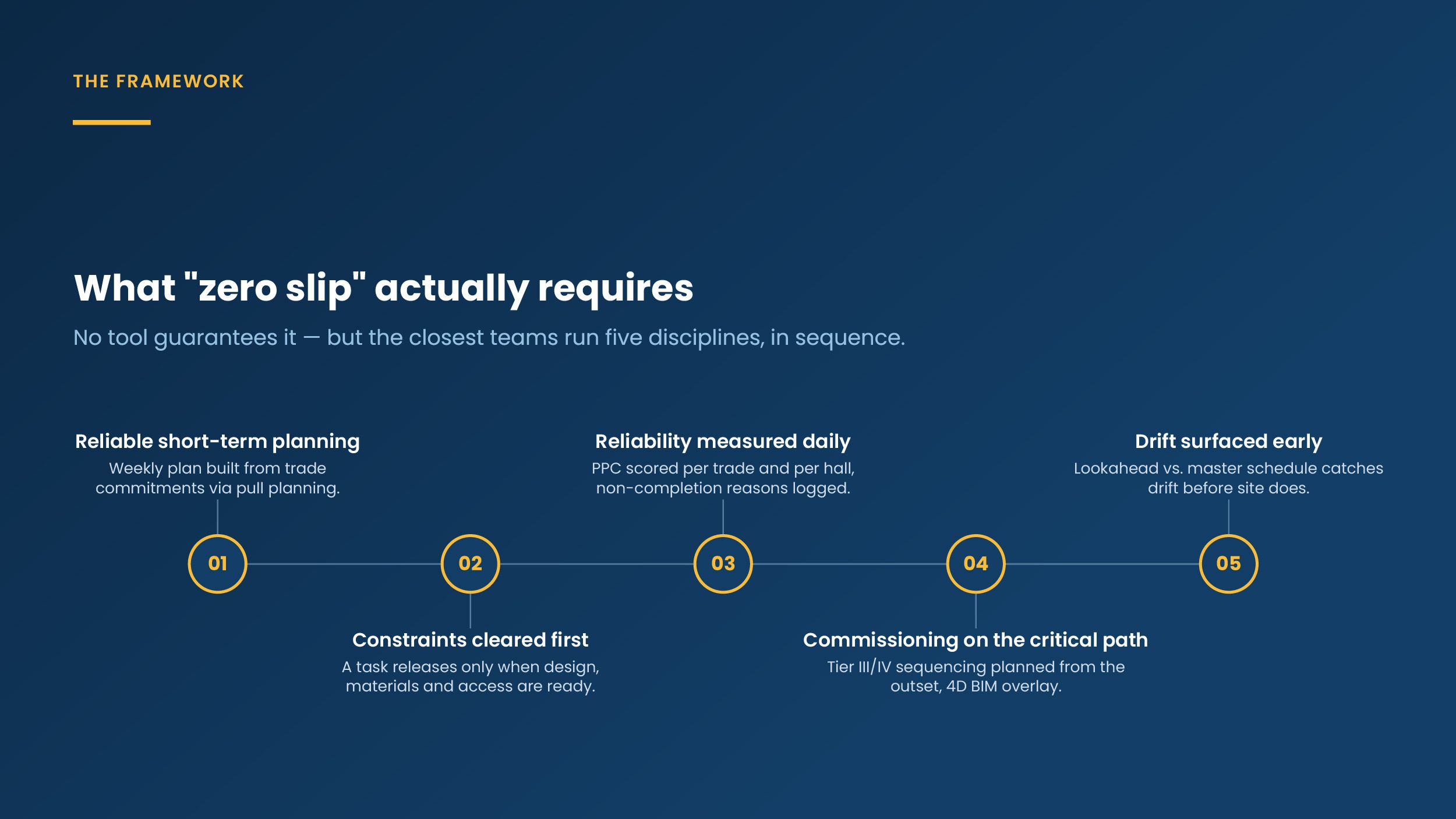
Zero slip is an aspiration, and no tool guarantees it. But the data centre teams that come closest share a way of working. It rests on five things.
Reliable short-term planning, not a top-down Gantt
The weekly plan is built from trade commitments through pull planning, not pushed down from a master Gantt that nobody on site believes. The master schedule still sets the milestones; the weekly work plan is how the trades actually commit to hitting them.
Constraints cleared before work is released
Make-ready planning means a task is only released when it is genuinely ready: design resolved, materials on site, prerequisite work complete, access available. On a data centre, where a stalled commissioning step can idle dozens of trades, clearing constraints ahead of time is where the schedule is protected.
Reliability measured daily
Percent Plan Complete scored per trade and per hall, with reasons for non-completion captured, turns planning into a daily feedback loop. You see which trades and which halls are slipping while there is still time to act, rather than discovering it at the milestone.
Commissioning sequenced as the critical path
Because commissioning decides time-to-power, it has to be planned as the critical path from the outset, sequenced alongside trade work rather than bolted on at the end. A 4D BIM overlay of planned versus actual makes the path to power visible and protects it.
Drift surfaced early
A lookahead overlaid against the P6, MSP, or Asta master schedule surfaces drift before it reaches the site, not weeks later in a report. Early warning is the whole game when there is no slack to absorb a surprise.
Coordinating 500+ trades in one live model
The coordination load is the defining challenge. Pull-planning weekly commitments across 500+ trades and 100+ MEP subcontractors, keeping every one aligned to the milestone, is impossible to do reliably across disconnected spreadsheets, emails, and standalone schedules.
The teams that manage it work from one live model: a shared, current picture where the lookahead, the live site, MEP and structural coordination, and the commissioning sequence all connect. Repetitive data halls and white-space lend themselves to Takt planning, where the production flow through each hall is made visible and repeatable rather than re-planned from scratch every time.
Protecting the path to power
It is worth repeating, because it is the single most important idea: on a data centre, the commissioning sequence is the critical path. Everything else exists to feed it. Sequencing Tier III and Tier IV commissioning workflows alongside the trade work, and overlaying planned against actual in 4D BIM, protects the path that actually determines whether the client gets power on the date they sold.
How VisiLean helps data centre teams hit the date
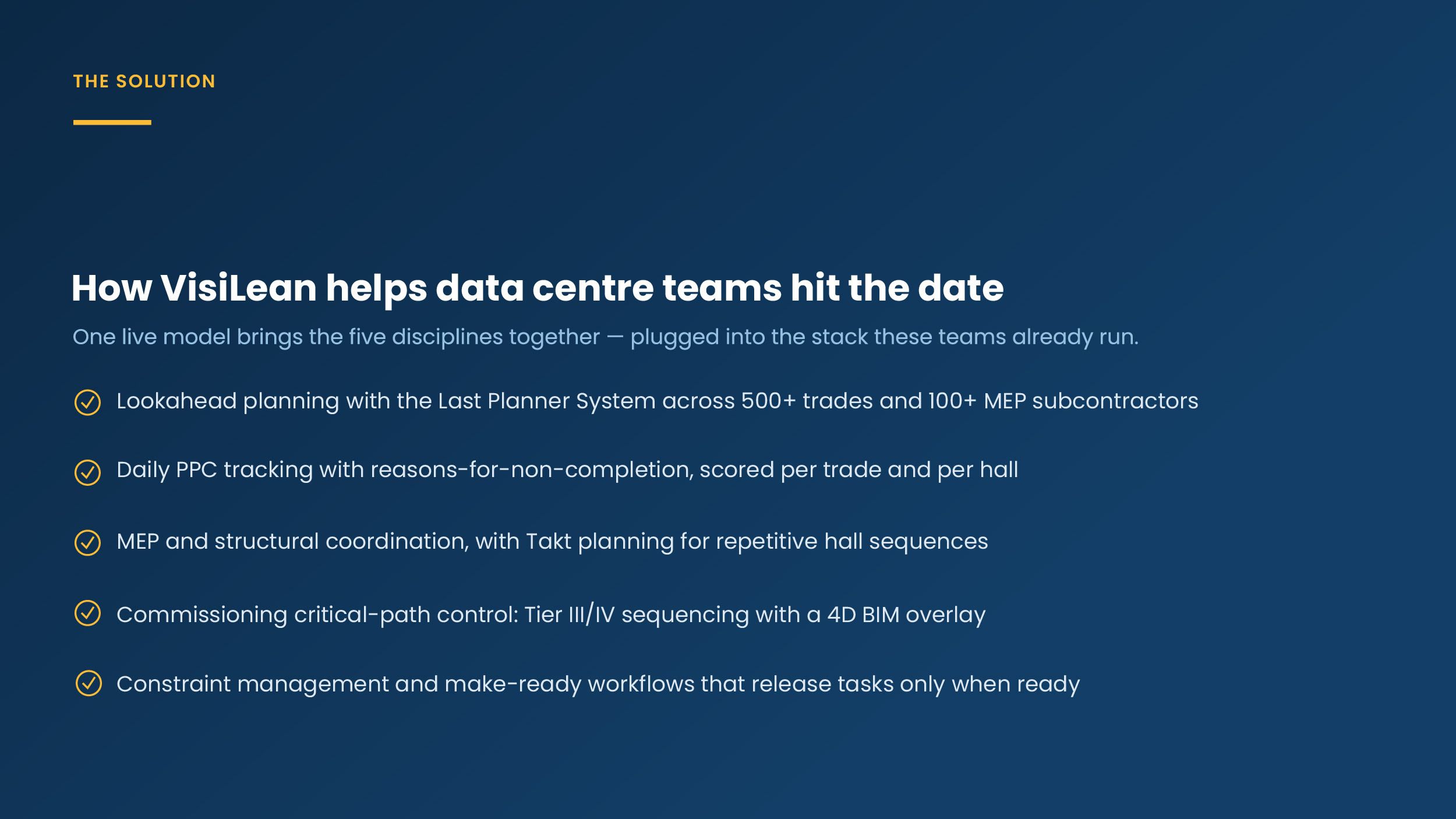
VisiLean is purpose-built for exactly this kind of delivery. It brings the five things above into one live model:
- Lookahead planning with the Last Planner System, pull-planning weekly commitments across 500+ trades and 100+ MEP subcontractors, with the P6 or MSP master schedule overlaid against site reality.
- Daily PPC tracking and reasons-for-non-completion, scored per trade and per hall.
- MEP and structural coordination, and Takt planning for repetitive hall sequences.
- Commissioning critical-path control, sequencing Tier III and Tier IV workflows with a 4D BIM overlay of planned versus actual.
- Constraint management and make-ready workflows that release tasks only when they are genuinely ready.
It plugs into the stack data centre teams already run, including Primavera P6, Microsoft Project, Autodesk Revit and Build, Bentley Synchro, Procore, Oracle Aconex, and Power BI, so there is no rip-and-replace. And it meets the security bar these clients demand, certified to ISO 27001 with Cyber Essentials and Cyber Essentials Plus.
The proof is on live projects. On Mercury's 19.6 MW PAR11 data centre in Paris, the team reached practical completion three months early using the Last Planner System and live 4D BIM coordination. Mace and CLN ran their data centre programme on a live model with daily commitment tracking and end-to-end 4D BIM integration. The pattern is consistent: when planning is reliable and commissioning is treated as the critical path, the date holds.
See how VisiLean delivers data centres to the date. Explore data centre delivery with VisiLean
Frequently asked questions
What is data centre commissioning?
Data centre commissioning is the structured process of testing and verifying that all systems, especially power, cooling, and controls, work together correctly so the facility can be safely energised and accepted. It is the final and most critical phase, and its sequence usually determines the project's time-to-power.
What is time-to-power in a data centre?
Time-to-power is the date the data centre can be energised and handed over ready for IT load. It is typically a fixed, contractual commitment the client has sold capacity against, which is why protecting it drives the entire construction and commissioning programme.
Why do data centre construction programmes slip?
Most slip comes from flow failures rather than slow work: MEP coordination clashes found on site, commissioning sequences blocked by incomplete prerequisites, unresolved constraints such as long-lead equipment, and a master schedule that does not reflect site reality until it is too late to recover cheaply.
How many trades are involved in a data centre build?
A large data centre build can involve more than 500 trades and over 100 MEP subcontractors working in overlapping space, which is why coordination and reliable short-term planning matter so much more than on a conventional project.
How does software help hit time-to-power?
Software helps by connecting the lookahead, live site progress, MEP coordination, and the commissioning sequence in one live model, measuring planning reliability daily, enforcing constraint removal, and treating commissioning as the critical path with a 4D BIM planned-versus-actual overlay, so drift is caught early rather than at the milestone.