Construction has a productivity problem that no amount of working harder seems to fix. For decades, while manufacturing and logistics transformed their output, construction productivity has barely moved. The people on site are not lazy, and the projects are not short of effort. Something else is going on.
Spend time around the best-performing project teams and a pattern emerges. They are not simply working harder than everyone else. They are working differently. The gap between a high-performing team and an average one is rarely about talent or hours; it is about a set of habits in how work is planned, coordinated, and controlled. This playbook sets out seven of them.
The productivity gap is a management problem, not an effort problem
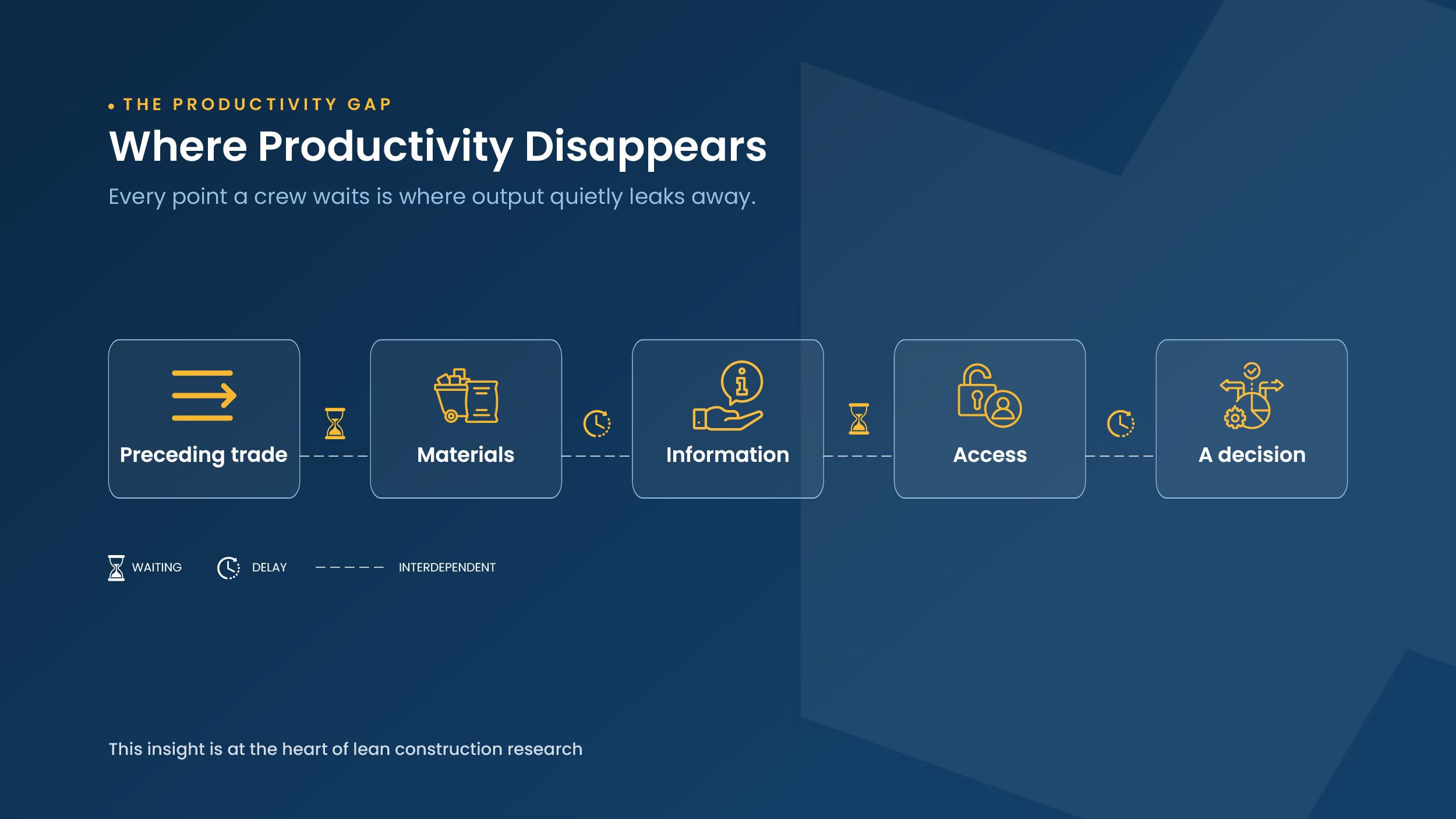
The uncomfortable truth is that most construction waste is designed into the way work flows, not caused by slow workers. Crews wait for the preceding trade, for materials, for information, for access, for a decision. Those hours of waiting never appear as anyone's fault, but they are where productivity quietly disappears.
This is the insight at the heart of lean construction research, including the production theory developed by Lauri Koskela and built on in the decades since: construction has traditionally managed only the act of building, while ignoring the flow of work between activities and the value delivered to the client. High-performing teams manage all three. They treat productivity as a property of the system, not the individual, and they design the flow of work so that people can actually be productive.
Here is what those teams do differently.
What high-performing construction teams do differently: seven habits
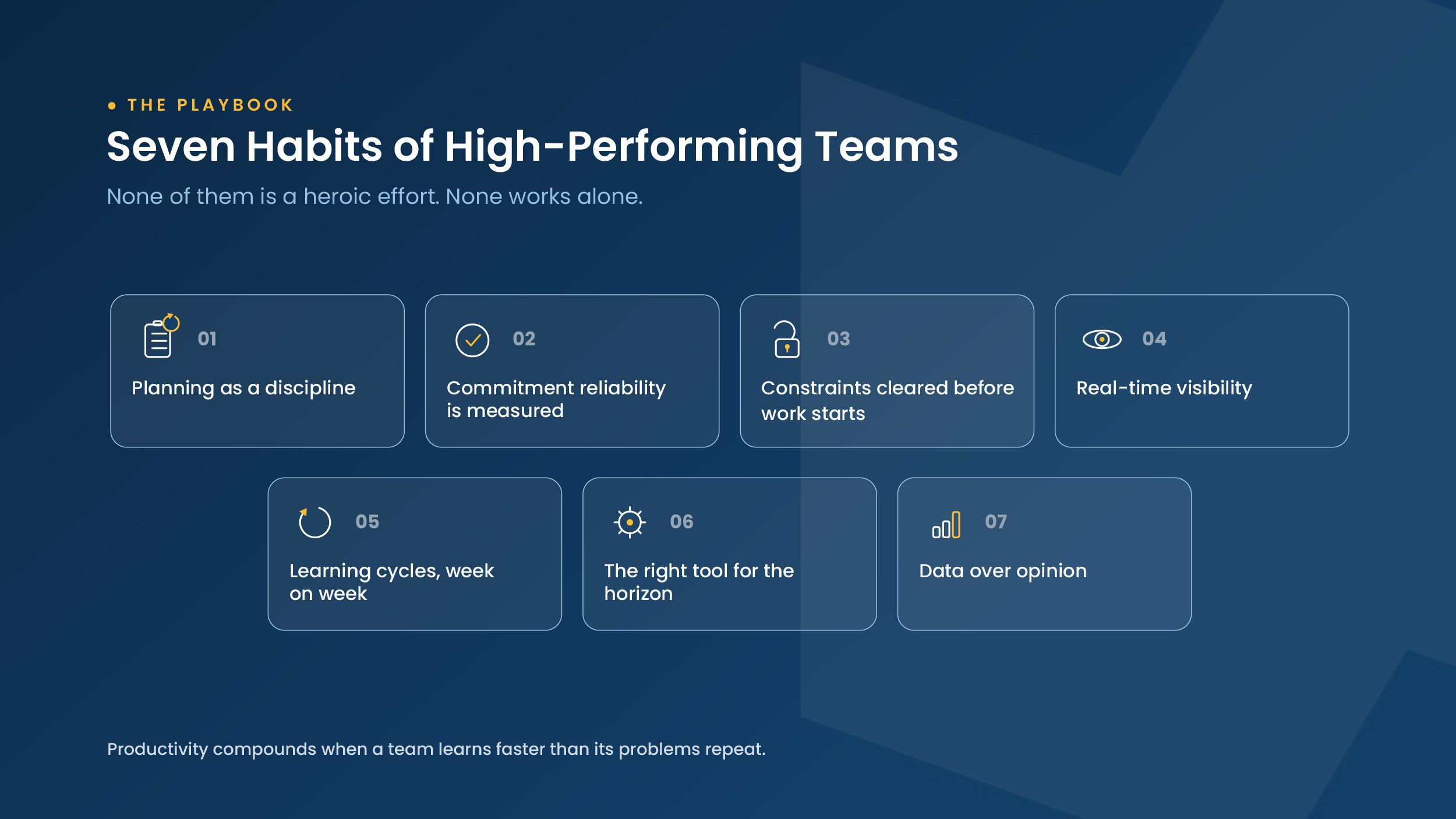
1. They treat planning as a discipline, not a document
On an average project, the programme is produced once, printed, and slowly drifts out of date. On a high-performing project, planning is a continuous discipline: a rhythm of master planning, look-ahead planning, and weekly commitments that keeps the plan connected to reality. The plan is not a document to be admired; it is a live instrument the team steers with.
2. They measure commitment reliability, not just progress
Average teams ask "are we on programme?" The best teams also ask "how reliably are we doing what we said we would?" They track the percentage of planned tasks actually completed, week after week. That single measure of commitment reliability exposes where the plan is failing before the schedule does, and it turns planning from a guessing game into a feedback loop.
3. They map and remove constraints before work starts
The difference between a task that can be done and a task that will be done is a set of constraints: design, materials, labour, equipment, access, prerequisite work. High-performing teams make constraints visible and clear them ahead of time, so that when a crew arrives, the work is genuinely ready. Making work ready is unglamorous and it is where most productivity is won.
4. They work from real-time visibility, not week-old reports
You cannot manage a fast-moving site from a report that is already days old. The best teams have a shared, current picture of what is planned, what is done, and what is stuck, updated from the field rather than reconstructed in the office. Real-time visibility shortens the distance between a problem appearing and someone acting on it.
5. They run learning cycles
When a planned task is not completed, average teams move on. High-performing teams ask why, capture the reason, and feed it back into the next plan. Over weeks, this simple habit of recording reasons for non-completion and acting on them turns recurring problems into solved ones. Productivity compounds when a team learns faster than its problems repeat.
6. They use the right tool for the work
A single master schedule cannot do everything. The best teams match the planning tool to the horizon: a critical path schedule for the backbone and milestones, look-ahead planning to make work ready, and short-term commitment planning for the week. Forcing all of it into one static Gantt chart is a common and quiet drag on construction workflow.
7. They decide with data, not opinion
In the average site meeting, the loudest voice or the most senior opinion wins. On the best projects, decisions rest on what the data shows: reliability trends, constraint status, actual progress against plan. Removing opinion from decisions that should be evidence-based is one of the fastest ways to lift construction productivity, because it stops the same arguments repeating every week.
Productivity is a system, not a sprint
Read those seven habits again and the theme is clear: none of them is a heroic effort, and none works alone. Planning discipline feeds commitment reliability. Constraint mapping makes commitments realistic. Real-time visibility powers the learning cycle. Data replaces opinion. They reinforce each other, which is exactly why high-performing teams pull ahead and stay ahead. Productivity is not a sprint anyone can win by pushing harder for a week; it is a system you build and maintain.
This is also why the latest construction technology trends matter less as individual gadgets and more as a way to connect these habits. Technology that digitises one task in isolation changes little. Technology that connects planning, commitments, constraints, progress, and data into one flow is what lets a team actually work this way at scale.
How VisiLean helps teams work this way
VisiLean was built directly on this thinking. It connects master planning and the critical path with lean look-ahead planning and weekly commitments, so planning stays a live discipline rather than a stale document. It makes constraints visible and tracks them to clear, measures commitment reliability week on week, and captures reasons for non-completion so teams learn. Progress is updated from the field in real time, and decisions are grounded in the data the platform surfaces rather than opinion in the room.
In other words, the seven habits of high-performing teams stop being things you have to remember to do, and become the way the system works.
See how VisiLean helps teams work this way. Explore the VisiLean platform
Frequently asked questions
What is construction productivity?
Construction productivity is a measure of how efficiently a project converts inputs, such as labour, materials, and time, into completed work. In practice it reflects how much of the team's effort turns into progress rather than being lost to waiting, rework, and coordination failures.
Why is construction productivity so low?
Most lost productivity in construction comes from poor flow between activities rather than slow work: crews waiting on the preceding trade, materials, information, or access. These delays rarely show up as anyone's fault, which is why they persist. Improving productivity is mainly about designing better flow, not pushing people harder.
How can construction teams improve productivity?
The highest-impact changes are managerial: treat planning as a continuous discipline, measure commitment reliability, remove constraints before work starts, work from real-time visibility, run learning cycles, match the planning tool to the work, and decide with data rather than opinion. These habits reinforce each other as a system.
What construction technology improves productivity?
The technology that moves the needle is not a single tool but a connected system that links planning, commitments, constraints, progress, and data into one workflow. Point solutions that digitise one task in isolation deliver little; connected platforms that support the way high-performing teams actually work deliver the most.