Every vendor has "AI" on the homepage. Some of it is doing real work on real projects; a lot of it is a chatbot in a trench coat. An honest map of what AI actually does on site in 2026 — and the data problem behind most failed pilots.
Every construction software vendor now has "AI" on the homepage. Some of it is doing real work on real projects. A lot of it is a chatbot in a trench coat. If you are trying to decide where artificial intelligence in construction is worth your attention and budget in 2026, the useful question is not "is AI coming" but "what does it actually do on my site today, and what is still a demo-stage promise?"
This is an honest map of AI for construction right now: where it earns its place, where it is oversold, and the one thing that decides whether any of it works for you.
Where AI genuinely helps in construction today
Strip away the marketing and a handful of AI use cases are already delivering value on live projects.
- AI in construction scheduling. The strongest current use case. AI can analyse a live programme, flag activities at risk of slipping, spot sequencing conflicts, and surface constraints that a human planner would take hours to find. It does not build the plan for you; it makes the plan you have far harder to get wrong.
- Automated progress capture. Computer vision can turn site photos, drone imagery, and 360 captures into objective progress and quality signals, cutting the manual effort of working out what is actually built versus what was planned.
- Risk and delay prediction. Where a contractor has enough clean historical data, models can score schedules for delay risk and highlight the activities most likely to cause knock-on problems.
- Document and information triage. AI is good at searching, summarising, and routing the mountain of RFIs, submittals, and correspondence a project generates, so the right information reaches the right person faster.
The common thread: today's real wins are AI as a decision-support layer for the people running the project, not AI running the project.
AI in construction: real vs hype
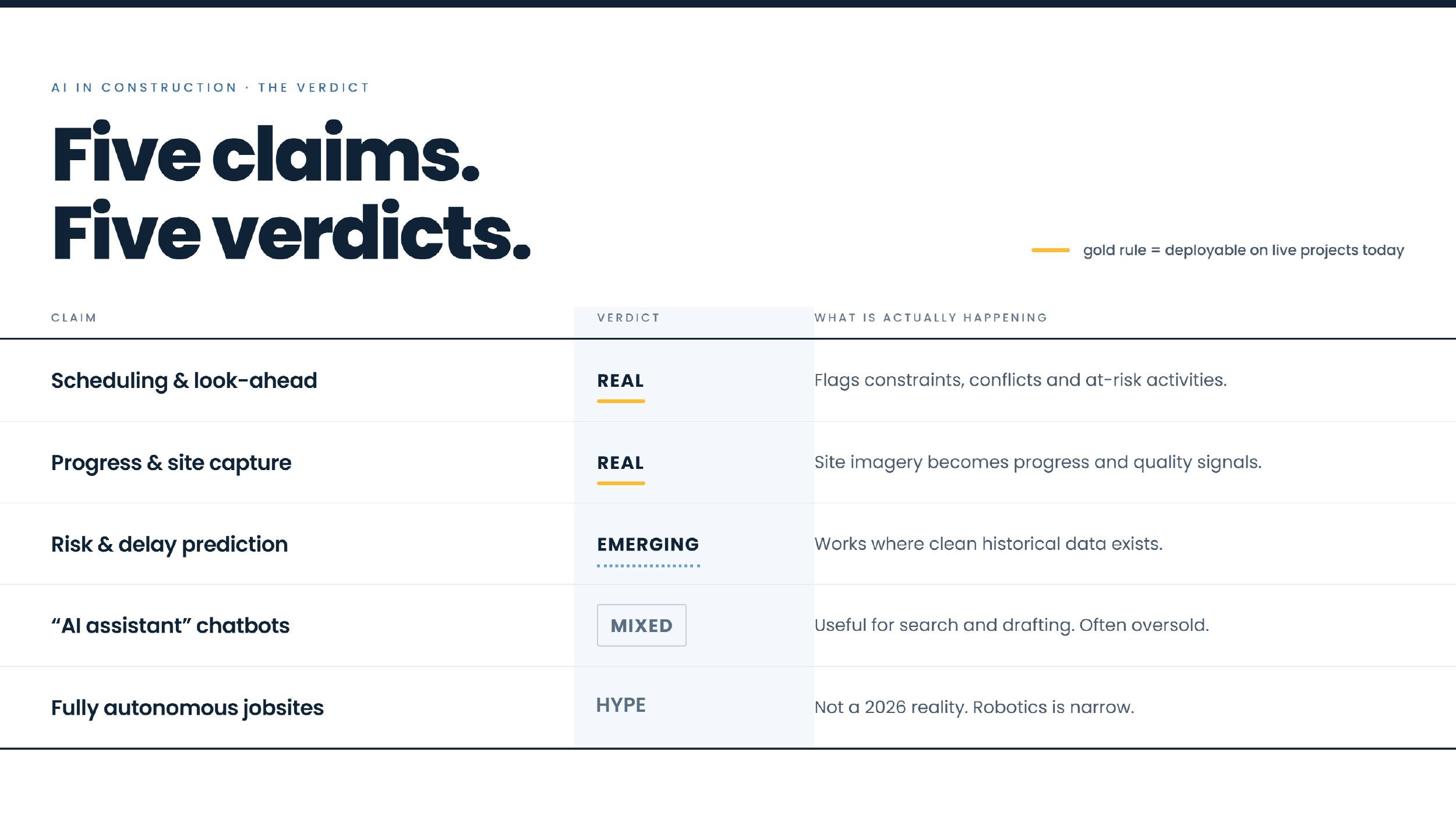
A quick reference for cutting through vendor claims:
| Area | Verdict | What is actually happening |
|---|---|---|
| Scheduling & look-ahead planning | Real | AI can flag constraints, sequence conflicts, and at-risk activities from live plan data. |
| Progress & site data capture | Real | Image and sensor data can be turned into progress and quality signals automatically. |
| Risk & delay prediction | Emerging | Useful where there is enough clean historical data; unreliable where there is not. |
| "AI assistant" chatbots | Mixed | Helpful for search and drafting; often marketed as more than it is. |
| Fully autonomous jobsites | Hype | Not a 2026 reality. Robotics is advancing but narrow and task-specific. |
Where AI is overhyped
Two patterns are worth watching for. The first is automation dressed up as intelligence: a fixed rule or a template that gets called "AI" because the label sells. The second is the autonomous-jobsite narrative, which makes for great conference keynotes but bears little resemblance to what most sites can deploy in 2026. Robotics and autonomy are advancing, but they are narrow, task-specific, and years from the general capability the headlines imply.
None of this means AI in construction is a gimmick. It means the value is concrete and specific, and the responsible thing a buyer can do is ask exactly which of the real use cases above a product actually delivers.
The real blocker nobody mentions: your data
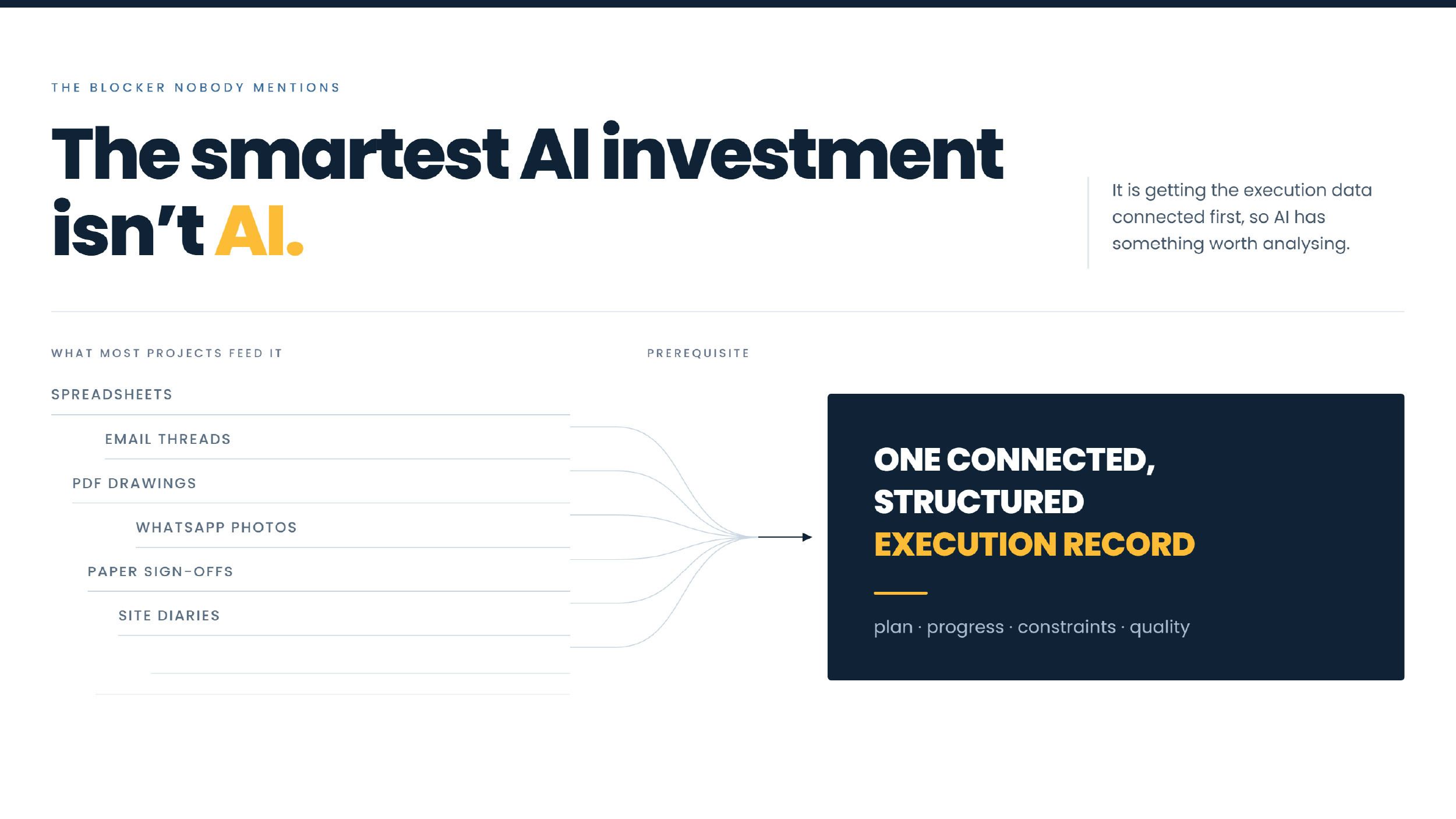
Here is the uncomfortable truth behind most failed AI pilots in construction. AI is only as good as the data it learns from, and the average project still runs on a scatter of spreadsheets, email threads, WhatsApp messages, PDFs, and paper. Feed that to even the best model and you get confident, useless answers.
This is why the teams getting real value from AI are almost always the ones who first got their execution data connected and structured. Clean, live data about the plan, the progress, the constraints, and the quality record is the raw material AI needs. Without it, AI has nothing dependable to reason about. With it, the same use cases above stop being demos and start being decisions.
In other words, the smartest AI investment a construction business can make in 2026 is often not an AI product at all. It is getting the execution layer connected first, so that AI has something worth analysing.
What to ask a vendor claiming AI
- Which specific decision does your AI improve, and can you show it on a live project rather than a demo?
- What data does it need to work, and where does that data come from on my project?
- Is this a prediction and recommendation, or just an automated rule you are calling AI?
- What happens to accuracy when my data is incomplete, which it usually is?
- Does it keep a human in the loop for decisions that carry cost or safety consequences?
Where this is heading
The credible near-term direction is not robots replacing crews. It is a steady expansion of AI as an assistant to the people who plan and deliver work: better look-ahead planning, earlier warning of delay and risk, less time spent hunting for information, and quality issues caught sooner. The projects that benefit first will be the ones whose data is already in order.
AI in construction is genuinely exciting. It is also, right now, more useful for making good teams faster than for replacing them. Treat it as a sharp tool with real edges, not magic, and it earns its place quickly.
VisiLean connects planning, progress, and quality into one live execution layer, the connected data foundation that makes AI in construction actually work. See how VisiLean connects construction execution.
Frequently asked questions
What is AI in construction?
AI in construction is the use of machine learning and related techniques to analyse project data and support decisions, such as spotting schedule risks, turning site photos into progress updates, or flagging quality issues. It augments the people running the project rather than replacing them.
What are examples of AI in construction?
Practical examples in 2026 include constraint and delay detection in planning, automated progress capture from site imagery, document and RFI triage, and risk scoring on schedules. More speculative uses, like fully autonomous sites, are still largely experimental.
Will AI replace construction workers or project managers?
No. The credible near-term picture is augmentation, not replacement. AI handles data-heavy pattern spotting so that skilled people can make better and faster decisions. The judgement, coordination, and accountability stay human.
What is the biggest barrier to using AI in construction?
Data. AI is only as good as the information it learns from, and most projects still run on fragmented spreadsheets, email, and paper. Without clean, connected execution data, AI has nothing reliable to work with, which is why a connected system matters before the AI does.