In short: Modular construction runs on two schedules at once, a factory production schedule and a site schedule, and most modular delays happen at the interface between them rather than inside either one. The real scheduling challenge is keeping the factory cadence and the site install cadence synchronised, with the site genuinely ready at the moment the modules arrive.
Modular and offsite construction promise speed, quality, and a controlled environment: build the elements in a factory, transport them to site, and install. On paper, it looks simpler than traditional construction. In practice, scheduling becomes harder, not easier, because you have not removed complexity. You have added a factory, a logistics chain, and a handoff, and it is that handoff where modular programmes most often come unstuck.
This piece looks at why modular construction runs on two clocks, what breaks when factory meets site, and what it takes to keep the two in sync.
Modular construction runs on two schedules
Traditional construction has one flow of work on one site. Modular has two, running in parallel and meeting at a single interface.
- The factory schedule is a production line. It rewards repetition, steady takt, and uninterrupted flow. Its enemy is anything that stops the line.
- The site schedule is conventional construction. Groundworks, access, craneage, module installation, and the MEP and structural connections that tie the modules together. Its enemy is being out of sequence.
These two have different rhythms and different failure modes, and they are often run by different teams on different systems. The programme only works if the output of the factory and the readiness of the site line up, module by module.
What breaks at the factory-site interface
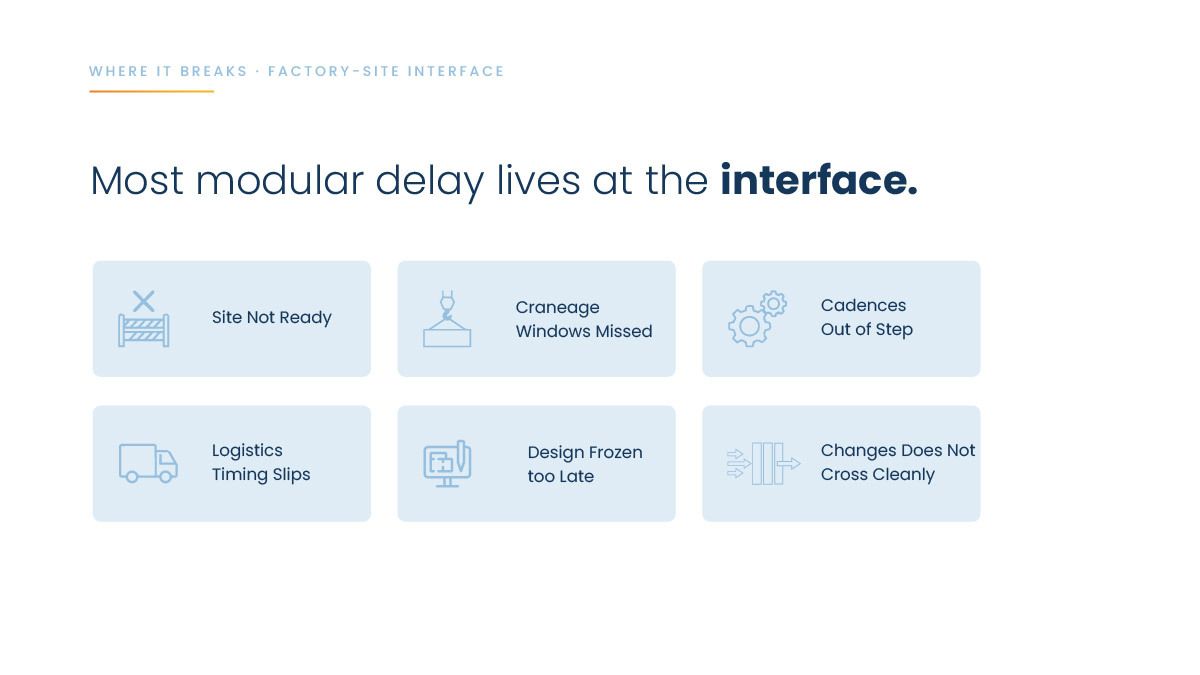
Almost every modular scheduling problem lives at this boundary:
- The site is not ready when the modules arrive. Foundations, access, or services are incomplete, so modules sit in storage, adding cost and risk of damage, or the factory has to slow down.
- The factory and site fall out of step. If the factory runs ahead of the install cadence, modules pile up; if it runs behind, the site is starved. Either way, the programme suffers.
- Logistics and transport timing slip. Just-in-time module delivery, oversized loads, permits, and tight delivery slots mean one missed window ripples through the sequence.
- Craneage windows are missed. Lifting capacity is often the bottleneck, and a module that is ready but cannot be lifted is no further forward.
- Design freezes too late. Modular demands design certainty far earlier than traditional construction, because a late change cannot simply be adjusted on site; it has to flow back into the factory.
- Change does not cross the boundary cleanly. A decision on site that affects module design has to reach the factory in time, and a factory variation has to reach the site. When that link is slow, both sides build to different versions of the truth.
None of these is a failure of effort. They are failures of coordination across an interface that traditional scheduling was never designed to manage.
Why traditional scheduling struggles with modular
A top-down Gantt treats a project as one linear sequence. Modular is not one sequence; it is two cadences that must be synchronised. A single master bar chart cannot easily model the dependency between a module leaving the line and the site being ready to receive it, and when the factory and site sit on separate systems that do not talk, drift at the interface only becomes visible once a module is already waiting on a truck or a slab is not poured. By then the cost is locked in.
What keeps factory and site in sync
The teams that run modular well treat the interface as the thing to manage, not an afterthought. In practice that means:
- Synchronising the two cadences. Takt planning gives both the factory line and the site install sequence a visible, repeatable rhythm, so the production rate and the install rate are designed to match rather than colliding.
- Making the site ready before modules arrive. Make-ready planning and constraint management clear foundations, access, craneage, and connections ahead of each delivery, so modules are installed, not stored.
- Freezing design early and managing change across the boundary. Constraints such as design sign-off and long-lead items are resolved in the lookahead, and changes are tracked so both factory and site build to the same version.
- Working from one live view across factory and site. A shared, current picture of production status and site readiness lets both sides see the interface, not just their own half of it.
- Measuring reliability on both sides. Tracking how reliably the factory and the site each hit their commitments, with reasons for non-completion captured, turns the interface into a feedback loop rather than a recurring surprise.
How VisiLean helps modular and offsite teams
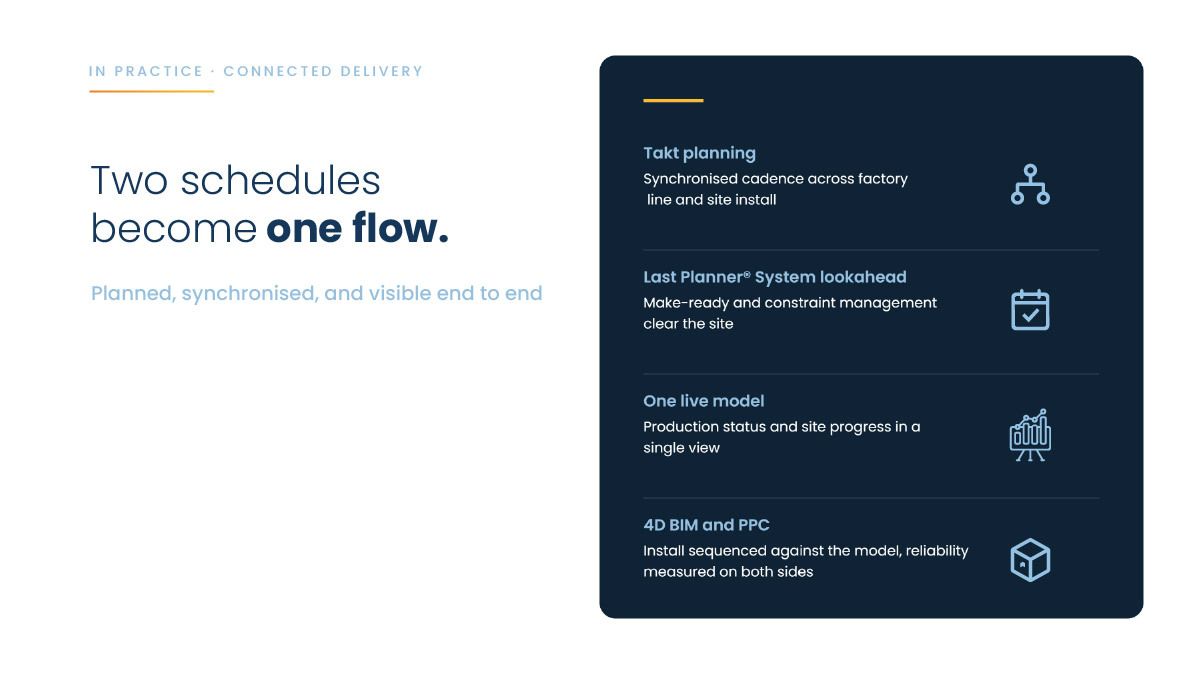
VisiLean is built for exactly this kind of connected, flow-based delivery, and offsite production management has long been part of how teams use it.
- Takt planning gives the factory production line and the site install sequence a visible, synchronised cadence.
- Lookahead planning with the Last Planner System, plus make-ready and constraint management, ensures the site is genuinely ready when each module lands, with design, logistics, and craneage constraints cleared in advance.
- One live model connects production status and site progress, so the factory-site interface is visible to everyone rather than hidden between two systems.
- 4D BIM sequences the install against the model, and daily PPC tracking measures reliability on both sides of the handoff.
- It integrates with the planning and BIM tools teams already run, and meets a high security bar, certified to ISO 27001 with Cyber Essentials and Cyber Essentials Plus.
The result is that the factory and the site stop being two schedules that happen to meet, and become one flow that is planned, synchronised, and visible end to end.
See how VisiLean connects factory and site. Explore VisiLean
Frequently asked questions
What is modular construction scheduling?
Modular construction scheduling is the planning and coordination of both the factory production of modules and their installation on site, including the logistics that link the two. Its defining challenge is synchronising the factory cadence with the site install cadence so modules are delivered and installed just as the site is ready for them.
Why is scheduling harder for modular and offsite construction?
Because there are two schedules running in parallel, a factory line and a site programme, plus a logistics chain connecting them. Complexity is not removed, it is moved to the interface between factory and site, which traditional single-sequence scheduling was not designed to manage.
What causes delays in modular construction?
Common causes are the site not being ready when modules arrive, the factory and site falling out of step, transport and craneage timing slipping, design freezing too late, and changes not crossing the factory-site boundary cleanly. Most are coordination failures at the interface rather than slow work.
What is the role of Takt planning in modular construction?
Takt planning gives both the factory production line and the site install sequence a steady, visible rhythm, so the rate of module production and the rate of installation are designed to match. This keeps the two cadences synchronised and avoids modules piling up or the site being starved.
How does software help coordinate factory and site?
Software helps by connecting factory production status and site readiness in one live model, synchronising the two cadences with Takt, clearing constraints before modules arrive through make-ready planning, sequencing installation in 4D BIM, and measuring reliability on both sides, so drift at the interface is caught early rather than discovered on a delivery truck.