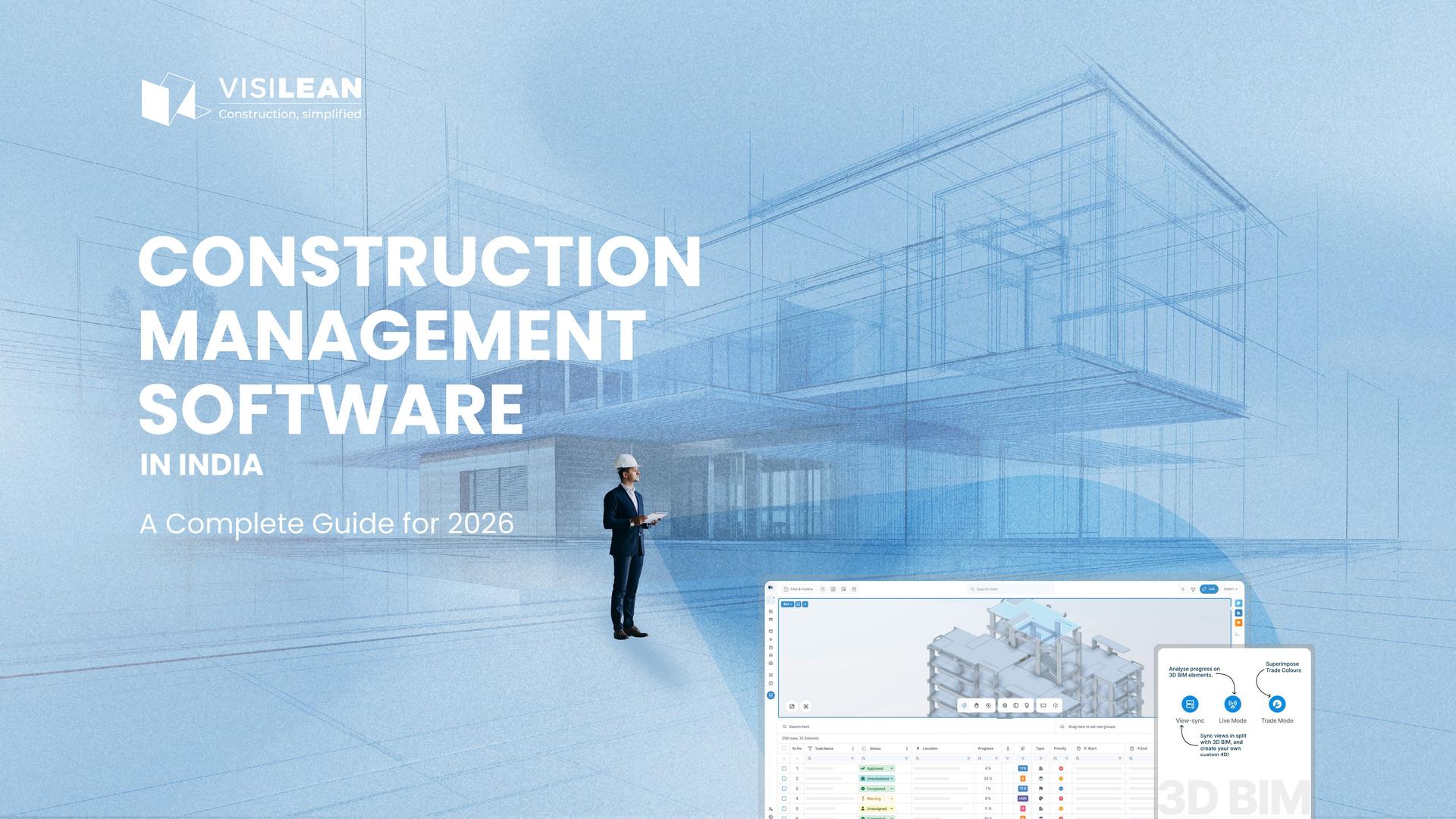
Discover how construction management software is transforming Indian projects in 2026. Learn key features, industry challenges, and how VisiLean helps teams deliver projects more efficiently.
Construction Management Software in India: A Complete Guide for 2026
Imagine this: your project schedule says everything is on track, but the reality on site tells a very different story.
The structural team is waiting for approvals. The MEP contractor cannot start because the workfront isn’t ready. Your planner is trying to reconcile multiple spreadsheet versions while site engineers continue sending updates through scattered WhatsApp groups. At the same time, the client expects accurate progress reports and clear answers on delays.
For many construction teams in India, this disconnect between planning and execution has become a daily challenge.
India’s construction industry is growing rapidly, driven by infrastructure investment, urban expansion, metro systems, airports, industrial facilities, and commercial developments. According to IBEF, the construction market is expected to reach $1.4 trillion by 2025. Yet despite this growth, the industry still faces significant productivity challenges.
McKinsey research highlights that construction productivity globally has grown by barely 1% annually over the past two decades. One of the main reasons is fragmented project management.
This is exactly why more organisations are adopting construction management software solutions. These platforms help teams improve coordination, increase visibility, and manage projects more proactively.
In this guide, we’ll explore what construction management software does, why it matters in 2026, and how VisiLean helps construction teams bridge the gap between planning and execution.
What is construction management software?
At its core, construction management software is a digital platform that helps teams plan, coordinate, track, and execute projects more effectively.
However, modern platforms do far more than simply manage schedules.
They create a connected environment where project information, workflows, communication, and reporting all come together in one place.
Instead of relying on:
-
Excel schedules
-
WhatsApp groups
-
Email chains
-
Manual reporting
-
Static Gantt charts
…teams can work from a single source of truth with real-time updates.
This improves:
Visibility across projects
Communication between teams
Accountability across trades
Decision-making speed
Workflow reliability
For construction teams managing multiple stakeholders and fast-moving projects, this level of coordination is becoming essential.
Why the Indian construction industry needs digital tools
India’s construction landscape is becoming increasingly complex.
Large infrastructure programmes, commercial developments, residential projects, and industrial facilities all involve multiple subcontractors, consultants, suppliers, and client teams working simultaneously.
Without connected systems, communication gaps quickly begin to affect delivery.
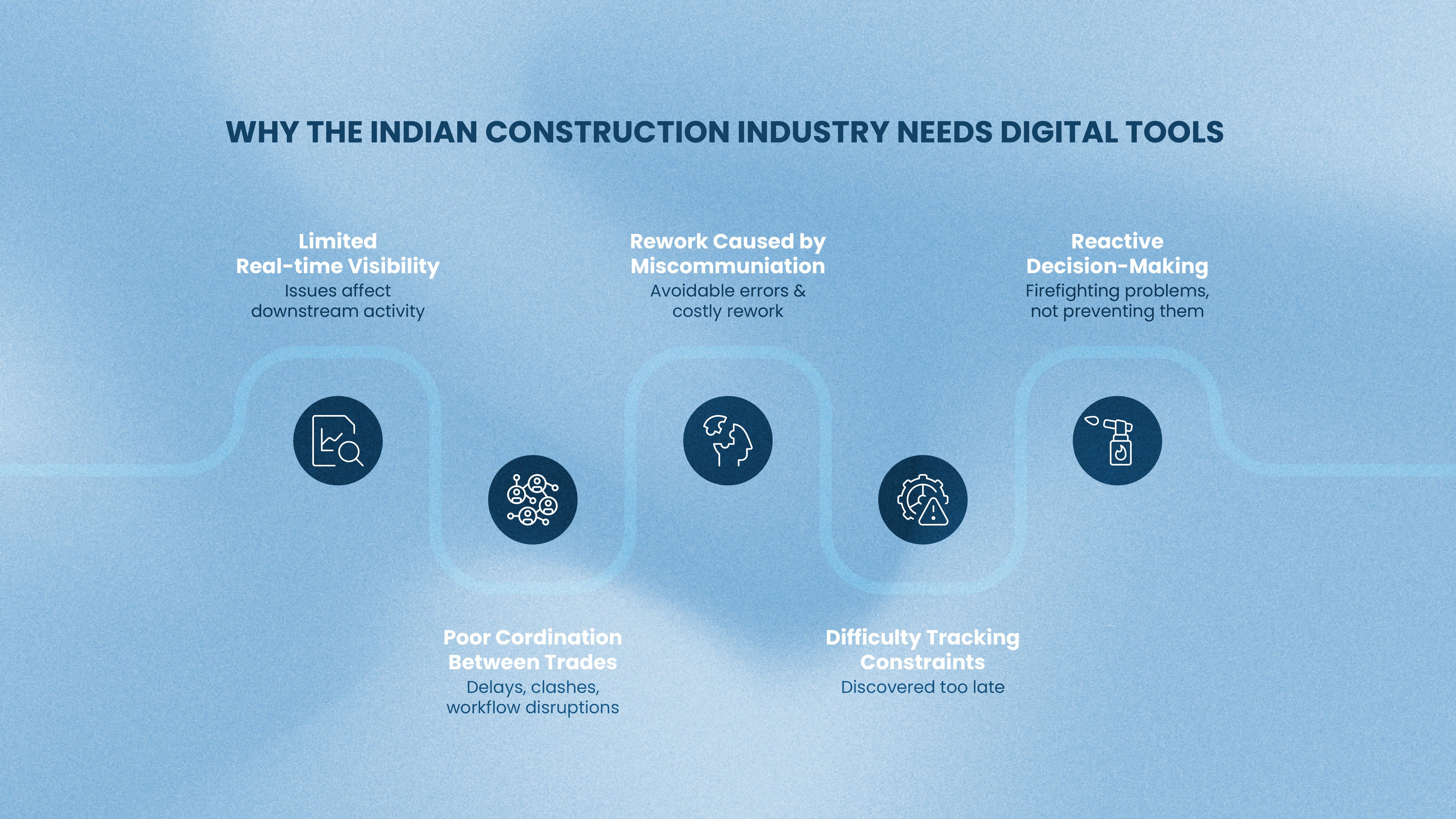
Some of the most common challenges construction teams face today include:
Limited real-time visibility
Many project managers still rely on delayed reporting from site teams. By the time issues appear in reports, they have often already affected downstream activities.
Poor coordination between trades
Different subcontractors frequently work from disconnected schedules, leading to delays, clashes, and workflow disruptions.
Rework caused by miscommunication
Outdated drawings, unclear instructions, and fragmented communication often result in avoidable errors and costly rework.
Difficulty tracking constraints
Material delays, pending approvals, labour shortages, and incomplete information are often discovered too late.
Reactive decision-making
Without real-time information, teams spend more time firefighting problems than preventing them.
This is where modern construction project management platforms deliver real operational value.
The key features construction teams should prioritise
Not all construction software platforms solve the same problems. The most effective systems are designed around real project delivery challenges rather than simply digitising paperwork.
Here are the features that matter most.
Collaborative planning and lookahead workflows
One of the biggest challenges in construction is ensuring that project plans reflect what can realistically happen on site.
Traditional schedules are often created centrally but fail during execution because constraints and trade dependencies were not properly considered.
Collaborative planning helps solve this issue by involving project stakeholders directly in planning workflows.
Lookahead planning enables teams to:
-
Identify upcoming constraints
-
Coordinate activities between trades
-
Improve workflow sequencing
-
Increase plan reliability
-
Reduce reactive firefighting
This creates smoother project execution and better alignment between planning and on-site delivery.
Learn more about collaborative planning
Real-time progress tracking
Construction projects move quickly, and waiting for weekly reports is no longer practical.
Modern construction management software allows site teams to update progress directly from mobile devices in real time.
This gives project managers immediate visibility into:
Task completion
Delays and blockers
Workforce productivity
Planned vs actual progress
Workflow performance
Real-time visibility allows teams to respond proactively instead of reacting after problems have already escalated.
It also improves transparency across stakeholders, ensuring everyone works from the same live information.
4D BIM and visual coordination
As projects become more complex, visual coordination is becoming increasingly important.
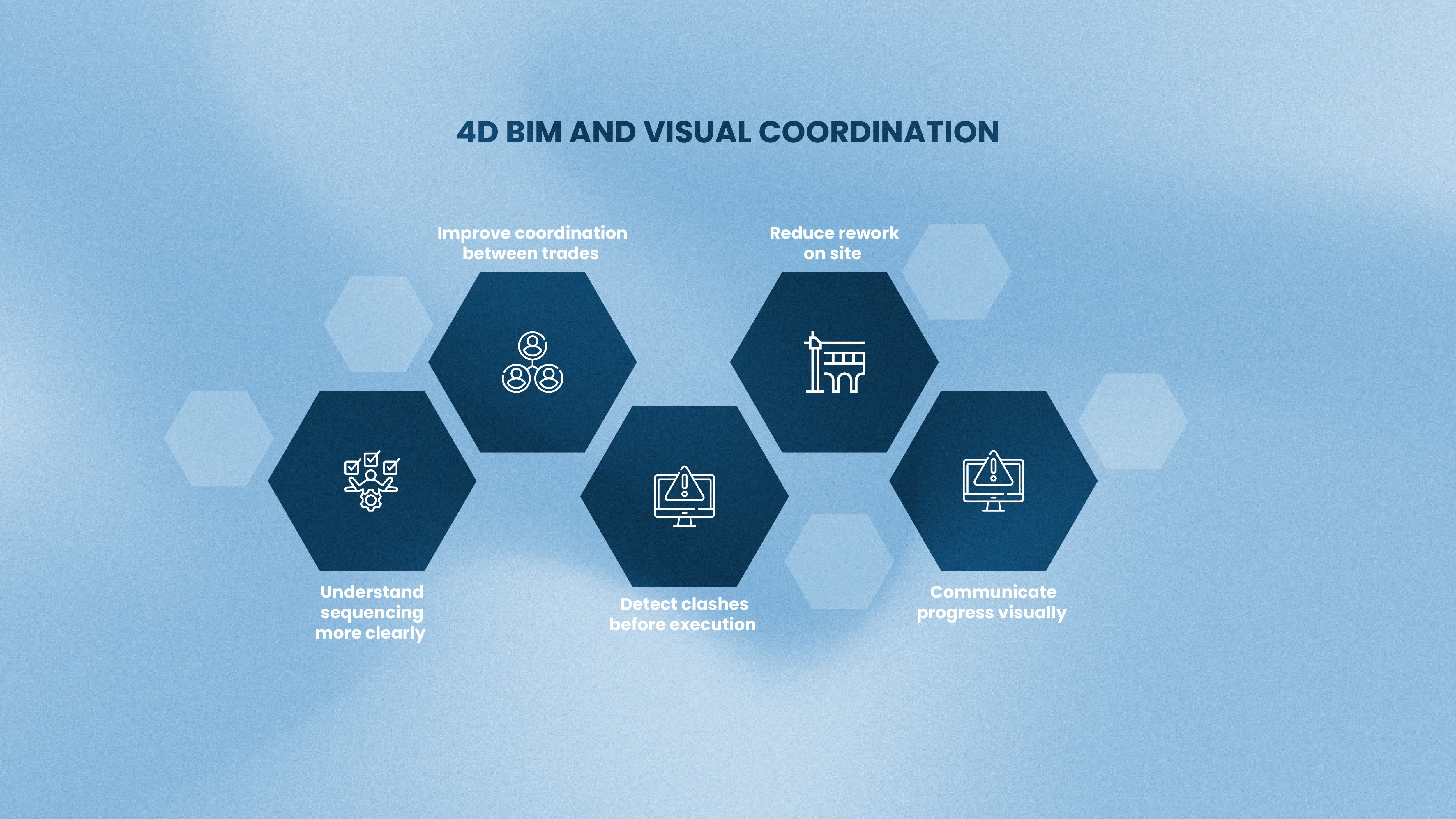
4D BIM combines project schedules with 3D BIM models to create a visual representation of how construction activities progress over time.
This helps teams:
Understand sequencing more clearly
Improve coordination between trades
Detect clashes before execution
Communicate progress visually
Reduce rework on site
For sectors such as data centres, aviation projects, and metro infrastructure, this level of visibility can significantly improve delivery certainty.
Explore VisiLean’s 4D BIM capabilities:
Constraint management and production control
Every construction project encounters constraints.
These may include:
Material shortages
Pending approvals
Resource limitations
Missing information
Design dependencies
The difference between projects that stay on track and projects that fall behind often comes down to how early these constraints are identified and resolved.
Constraint management systems allow teams to:
Log blockers systematically
Assign accountability
Track resolution progress
Prevent tasks from starting prematurely
This improves production flow and supports stronger project control throughout the lifecycle.
Read more about constraint management
How VisiLean supports modern construction delivery
VisiLean combines Lean construction methodologies with BIM-enabled workflows to support better planning, coordination, and execution.
Rather than functioning purely as reporting software, the platform focuses on improving day-to-day project delivery.
Collaborative planning workflows
VisiLean integrates:
Phase Planning
Lookahead Planning
Weekly Work Plans
…within one connected environment.
Teams can import schedules from Primavera P6 or Microsoft Project and convert them into executable production plans aligned with actual site conditions.
LiveSite mobile updates
VisiLean’s LiveSite mobile app enables site teams to:
Capture progress updates
Log delays and constraints
Upload photos
Track completed work
…directly from the field in real time.
This significantly improves communication between site and office teams.
4D BIM visualisation
By linking BIM models with live schedules, VisiLean enables teams to visualise planned versus actual progress across the project.
This helps improve:
Trade coordination
Sequencing clarity
Stakeholder communication
Clash prevention
…particularly on complex projects involving multiple overlapping trades.
Interactive dashboards and PPC tracking
VisiLean provides dashboards that help teams monitor:
Percentage of Plan Complete (PPC)
Constraint status
Trade performance
Planned vs actual progress
Workflow reliability
These insights support continuous improvement and stronger production management.
The benefits construction teams experience
When construction teams adopt connected digital workflows, teams often begin seeing improvements within weeks.
Some of the most common benefits include:
Better coordination between trades and subcontractors
Faster issue resolution
Improved workflow visibility
Reduced rework and communication errors
More reliable project schedules
Increased accountability across teams
Greater productivity on site
Perhaps most importantly, teams spend less time chasing information and more time delivering productive work.
The future of construction management in India
The future of construction in India is closely tied to digitalisation.
As projects continue becoming larger and more complex, disconnected workflows and manual reporting will become increasingly difficult to manage.
Forward-thinking organisations are already moving towards:
Real-time project visibility
BIM-enabled workflows
Data-driven planning
Lean production management
Collaborative coordination systems
Construction management software is no longer simply an operational tool. It is becoming a strategic advantage for organisations looking to improve delivery certainty and remain competitive.
Platforms like VisiLean are helping construction teams bridge the gap between planning and execution through connected Lean-BIM workflows designed specifically for the realities of modern construction projects.
Frequently Asked Questions
1. What is construction management software used for?
It helps teams manage planning, coordination, reporting, progress tracking, and communication within one connected platform.
2. How does construction software improve project delivery?
It improves visibility, accountability, workflow coordination, and decision-making while reducing delays and rework.
3. Is construction management software suitable for smaller contractors?
Yes. All companies/contractors are dealing with complexities and uncertainties of construction. Having a system in-place promises stable and efficient scaling.
4. What role does 4D BIM play in construction management?
4D BIM links schedules to 3D BIM models, helping teams visualise sequencing, improve coordination, and identify clashes before work begins.
5. Can site teams use VisiLean easily?
Yes. VisiLean’s LiveSite mobile application is designed specifically for site teams and supports real-time progress reporting.
6. How quickly can teams see results?
Many teams notice improvements in planning reliability, coordination, and visibility within the first 3 months.
Final Thoughts
Managing construction projects in India is becoming increasingly challenging as project complexity, stakeholder expectations, and delivery pressures continue to rise.
Relying on spreadsheets, fragmented communication, and reactive workflows makes it difficult to maintain schedule certainty and operational efficiency.
Construction management software helps teams improve collaboration, strengthen workflow visibility, and create more reliable project delivery processes.
For organisations looking to modernise project delivery in 2026 and beyond, VisiLean offers a practical, Lean-driven platform designed specifically for the realities of construction work.
Book a demo with us for your project success!
Don't get left behind. Discover how VisiLean can enable your teams to be more efficient. Want to know more? Head to our YouTube channel, or visit our website, to learn about all our features and book a demo with our team!