PERT, CPM, Takt, LPS®, location-based planning — each has strengths and blind spots. Discover why adaptability, not methodology, determines project success.
Here's a question that's been debated in project offices, site cabins, and planning workshops for decades: what's the best way to plan a construction project?
Ask a scheduling consultant and they'll say CPM. Ask a lean practitioner and they'll say Last Planner® System. Ask someone who's delivered ten data centre fit-outs back-to-back and they'll swear by Takt. Talk to a risk analyst scoping a first-of-its-kind infrastructure programme, and they'll pull out PERT.
They're all right. And they're all only telling part of the story.
Construction is arguably the most complex project-based industry on earth. A single project can involve hundreds of trades, thousands of interconnected activities, shifting labour availability, procurement uncertainties, design revisions, weather disruptions, and spatial constraints that change by the week. According to McKinsey, large construction projects typically take 20% longer to finish than scheduled and can run up to 80% over budget — and much of this traces back to planning and coordination failures.
Here's the uncomfortable truth: no single planning technique was designed to handle all of that. Each method solves a real problem — but each one also leaves gaps that the others fill. And yet, even when you try to combine them, the question remains: which two? Which three? All of them at once? Is that even practical on a live project with real deadlines, limited planning resources, and a site team that barely has time to update a spreadsheet, let alone master five methodologies?
That's the question this blog sets out to answer — honestly, without pretending there's a neat, universal solution.
Why Construction Planning Is Harder Than It Looks
Before we examine individual methods, it's worth acknowledging why construction planning is fundamentally difficult — and why the "which method is best?" debate never produces a satisfying answer.
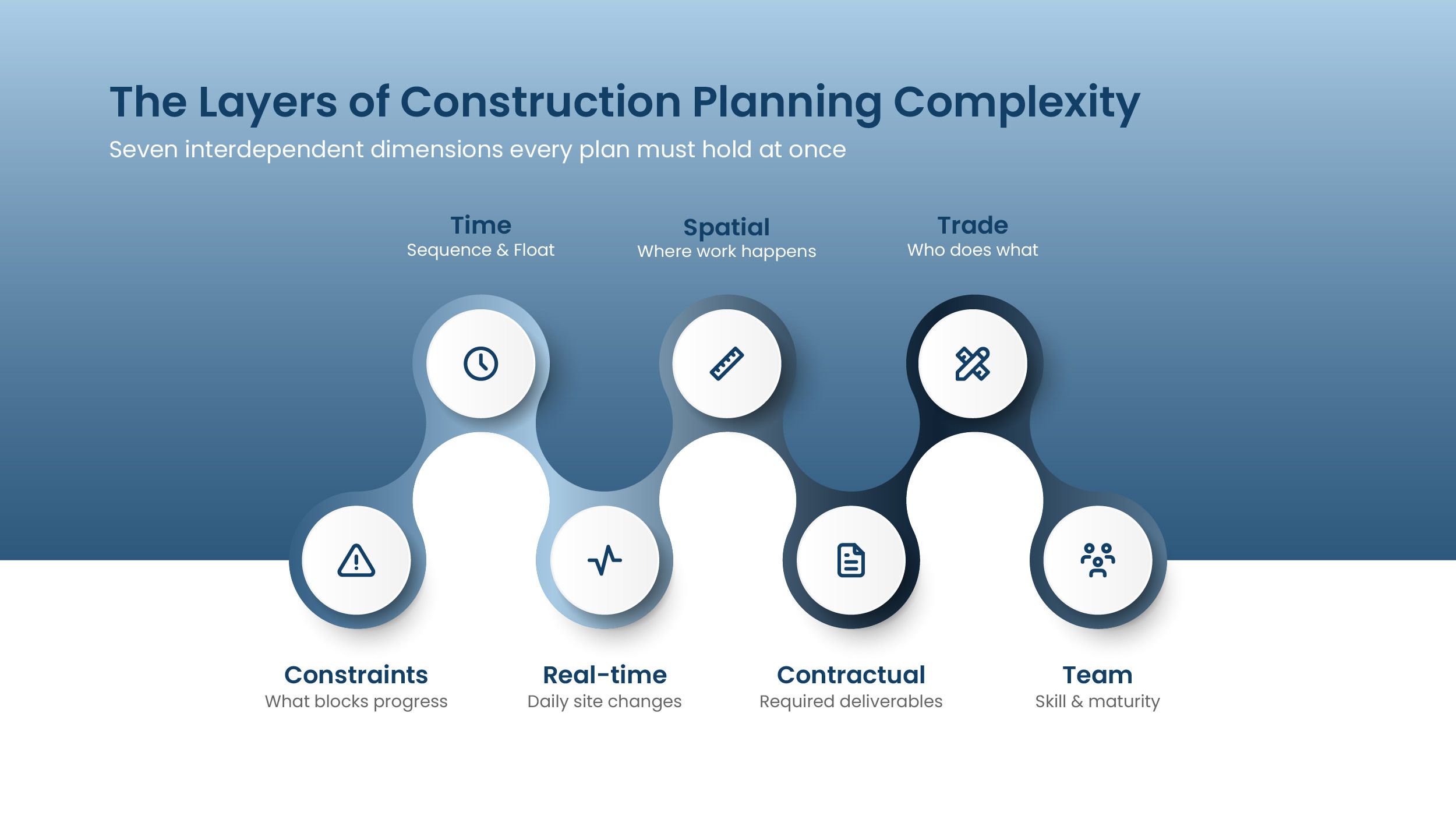
Construction projects operate across multiple dimensions simultaneously. You're managing time (when activities happen), space (where they happen), resources (who does them), dependencies (what must happen first), and constraints (what's blocking progress). On top of that, the plan must serve multiple audiences — the client wants milestone visibility, the planner needs critical path logic, the site engineer needs weekly commitments, and the subcontractor needs clarity on their scope and sequencing.
But methodology is only half the puzzle. External factors shape planning decisions just as much as the techniques themselves:
Team capability and digital maturity — a method is only as good as the team's ability to implement it. A brilliant Takt plan means nothing if the site team has never worked in Takt before and doesn't trust the process.
Site dynamics — no two sites behave the same way. Congested urban sites, remote infrastructure corridors, live operational environments, and greenfield developments each create different planning pressures.
Project-specific context — a 50-storey residential tower with repetitive floor plates has completely different planning needs than a bespoke data centre with dense MEP coordination across unique zones.
Contractual obligations — contracts often dictate the scheduling methodology. Many clients and main contractors require CPM-based programmes as contractual deliverables, regardless of what execution-level methods the delivery team might prefer.
These realities mean that the "ideal" planning approach isn't just a technical question — it's a contextual one. And context changes from project to project, phase to phase, sometimes week to week.
With that in mind, let's examine each method — not just what it does well, but where it genuinely falls short.
The Planning Methods: Strengths, Limitations, and Honest Gaps
CPM: The Industry's Backbone — But Only Half the Conversation
CPM (Critical Path Method) is the dominant scheduling methodology in construction worldwide. Primavera P6, Microsoft Project, Asta PowerProject — every major scheduling tool is built around CPM logic. It sequences activities based on dependencies, calculates the earliest and latest start and finish dates, identifies the critical path that drives the project duration, and provides float values that show where flexibility exists.
What CPM does well:
CPM is unmatched for creating the structural backbone of a project programme. It provides clear milestone logic, a clear breakdown of all the work packages with their contractual timelines, critical path visibility, and the framework for resource loading and what-if analysis. It answers the fundamental question: "What's the plan, and when should the project finish?"
Where CPM falls short:
CPM is fundamentally a top-down system with no built-in mechanism for bottom-up input. The planner creates the programme of what "should" be done, and the site team is expected to execute it. But the people closest to the work — the subcontractors, trade foremen, and site engineers — generally have limited input in shaping the schedule they're measured against.
This creates a dangerous gap. The programme reflects what should happen in an ideal sequence, not what can happen given the real constraints on site. When trade teams don't have input into the plan, they don't feel ownership over it. When they don't feel ownership, they don't commit to it. And when they don't commit, the schedule becomes a document that lives in the planner's laptop — disconnected from the reality unfolding on the ground.
CPM also provides no framework for proactive constraint management. When a CPM activity shows as "delayed," the delay has already happened. The system diagnosed the problem after the fact rather than preventing it.
PERT: Thoughtful About Uncertainty — But Still Idealistic
PERT (Program Evaluation and Review Technique) addresses something CPM ignores entirely: the fact that activity durations are uncertain. Instead of assigning a single fixed duration, PERT uses three estimates — optimistic, most likely, and pessimistic — and calculates a weighted expected duration.
What PERT does well:
PERT is genuinely valuable during early-stage planning when historical data is scarce and scope is still evolving. For first-of-a-kind projects, complex infrastructure programmes, or risk analysis exercises, PERT provides a more honest picture of the timeline than a single-point estimate ever could. It forces teams to acknowledge that uncertainty exists rather than hiding behind false precision.
Where PERT falls short:
While PERT is considerate of uncertainty, it handles it in a fundamentally idealistic manner. The three-estimate model assumes that if you capture the range of possibilities upfront, you've adequately accounted for variability. In reality, construction uncertainty isn't a static range that you calculate once and move on from — it's dynamic, emergent, and constantly evolving.
Materials get delayed mid-programme. Design revisions arrive three weeks into execution. A subcontractor's crew is pulled to another project. The weather turns. A regulatory inspection takes twice as long as expected. These aren't risks you can model with an optimistic-pessimistic range at the start of the project — they're live disruptions that require real-time adaptation in the field.
PERT helps you build a more honest plan at the outset, but it offers no mechanism for managing the dynamic nature of site reality once execution begins. No site engineer re-runs probability calculations during a Tuesday morning progress meeting. The gap between PERT's elegant estimation and the messy, shifting reality of a live construction site is wider than most textbooks admit.
LPS®: The Power of Bottom-Up — But Where's the Finish Line?
The Last Planner® System (LPS) emerged from the lean construction movement and represents a fundamentally different philosophy from CPM. Where CPM plans top-down from the schedule, LPS plans bottom-up from the people doing the work.
LPS operates across multiple planning horizons — phase scheduling, lookahead planning (typically 4–12 weeks), weekly work plans, and daily huddles. Its core innovation is commitment-based planning: rather than imposing targets from above, LPS asks the people closest to the work (the Last Planners®) to make realistic promises about what they will complete — through effective mapping and resolution of constraints, and making work ready before work is released to site. These commitments are tracked through a weekly metric defined as Percentage of Plan Complete (PPC), which measures plan reliability over time.
What LPS® does well:
LPS is exceptional at execution-level planning. It gives trades genuine ownership of the plan. It introduces constraint management — systematically identifying and removing blockers before they disrupt work. It creates accountability through commitments rather than imposed targets. And it drives continuous improvement by tracking why tasks fail and feeding those lessons back into future planning.
Where LPS falls short:
Here's the tension that lean practitioners don't always acknowledge openly: LPS is brilliant at managing variability at the weekly level, but it can lose sight of the overall project targets. When teams focus on weekly PPC and make-ready planning without a strong connection to the master programme, something paradoxical happens — PPC looks healthy, weekly commitments are being met, but the project is still drifting past its contractual completion date.
LPS, on its own, lacks a robust mechanism for controlling project forecasting and the end date. While LPS acknowledges the "should" targets from the top-down master schedule, it doesn't inherently offer mechanisms to control those milestones and manage the overall plan for accurate forecasting. It was never designed to replace the critical path or master milestone logic — it was designed to sit on top of it. But when the connection between weekly commitments and the overall programme isn't maintained, bottom-up planning becomes locally optimised but globally misaligned. The trades are hitting their weekly targets, but the project is still late.
This is why LPS without a CPM backbone is risky — and why CPM without LPS execution is equally fragile. Each method's limitation is precisely what the other compensates for.
Takt Planning: Beautiful in Theory — But Not Easy in Practice
Takt Planning borrows from manufacturing's concept of Takt time — the consistent pace at which work must be completed. In construction, Takt divides the project into zones and organises trades into wagons (groups that move through each zone together at a fixed rhythm). When one trade finishes a zone, the next moves in, thereby forming a train of wagons that pass through each zone at a defined Takt. The entire project operates to a single beat.
What Takt does well:
When Takt works, it's remarkable. It creates predictable production flow, makes bottlenecks immediately visible, synchronises trade coordination, and eliminates the start-stop-wait cycles that plague most construction sites. For repetitive work — hotel rooms, residential floor plates, data centre fit-outs — Takt can transform chaotic site delivery into a rhythmic, almost manufacturing-like process.
Where Takt falls short:
Let's be honest about three things.
First, Takt is difficult to implement. It requires significant upfront effort to define zones, establish the Takt time, balance trade durations across zones, and get each calculation right, before getting every subcontractor to buy into working at a rhythm that may not match their natural pace. On projects where teams haven't worked in Takt before, the learning curve can be steep and the resistance considerable.
Second, Takt is limited in applicability. It works brilliantly for repetitive work packages, but construction projects are rarely 100% repetitive. Structural works, complex MEP tie-ins, external works, and early enabling phases often don't lend themselves to a Takt rhythm. Teams end up using Takt for the repetitive fit-out phases but need entirely different approaches for everything else, unless the overall project execution strategy matches that of a production line — i.e., pre-fab manufactured units and installation.
Third, Takt still lacks widespread industry acceptance. While it's gained significant traction in Northern Europe and parts of the US, many markets, clients, and contractual frameworks are built around CPM-based scheduling. Proposing a Takt-based programme to a client who expects a P6 Gantt chart can create contractual and cultural friction that has nothing to do with whether Takt is a better methodology.
Location-Based Scheduling: Essential — But Not a Hero on Its Own
Location-Based Management System (LBMS) approaches planning from a spatial perspective, organising the schedule around physical locations — floors, zones, sections, areas — rather than just activity logic and dependencies.
What location-based scheduling does well:
The core insight is powerful: construction doesn't just happen in time — it happens in space. Two activities that appear independent on a Gantt chart might clash on site because they occupy the same area. LBMS makes spatial conflicts visible, helps plan trade flow across locations, and is particularly effective for repetitive and linear projects — residential towers, highways, rail, and tunnels.
Where location-based scheduling falls short:
Here's what's interesting about location-based scheduling: it's absolutely essential as a planning dimension, but it rarely stands alone as a planning method. In practice, location-based thinking blends into other techniques rather than operating as an independent hero.
When you plan in Takt, you're inherently thinking location-based — zones are spatial. When you do lookahead planning in LPS, you're considering location when determining make-readiness. When a CPM planner organises activities by floor or area, they're applying location-based logic within a CPM framework.
LBMS's strength is that it adds spatial awareness to whatever planning approach you're using. Its limitation is that, without the scheduling logic of CPM, the execution discipline of LPS, or the production rhythm of Takt, a purely location-based plan lacks the mechanisms to actually drive delivery.
The Complementary Paradox: Every Method Needs What the Others Provide
Here's where this gets genuinely interesting — and equally complicated.
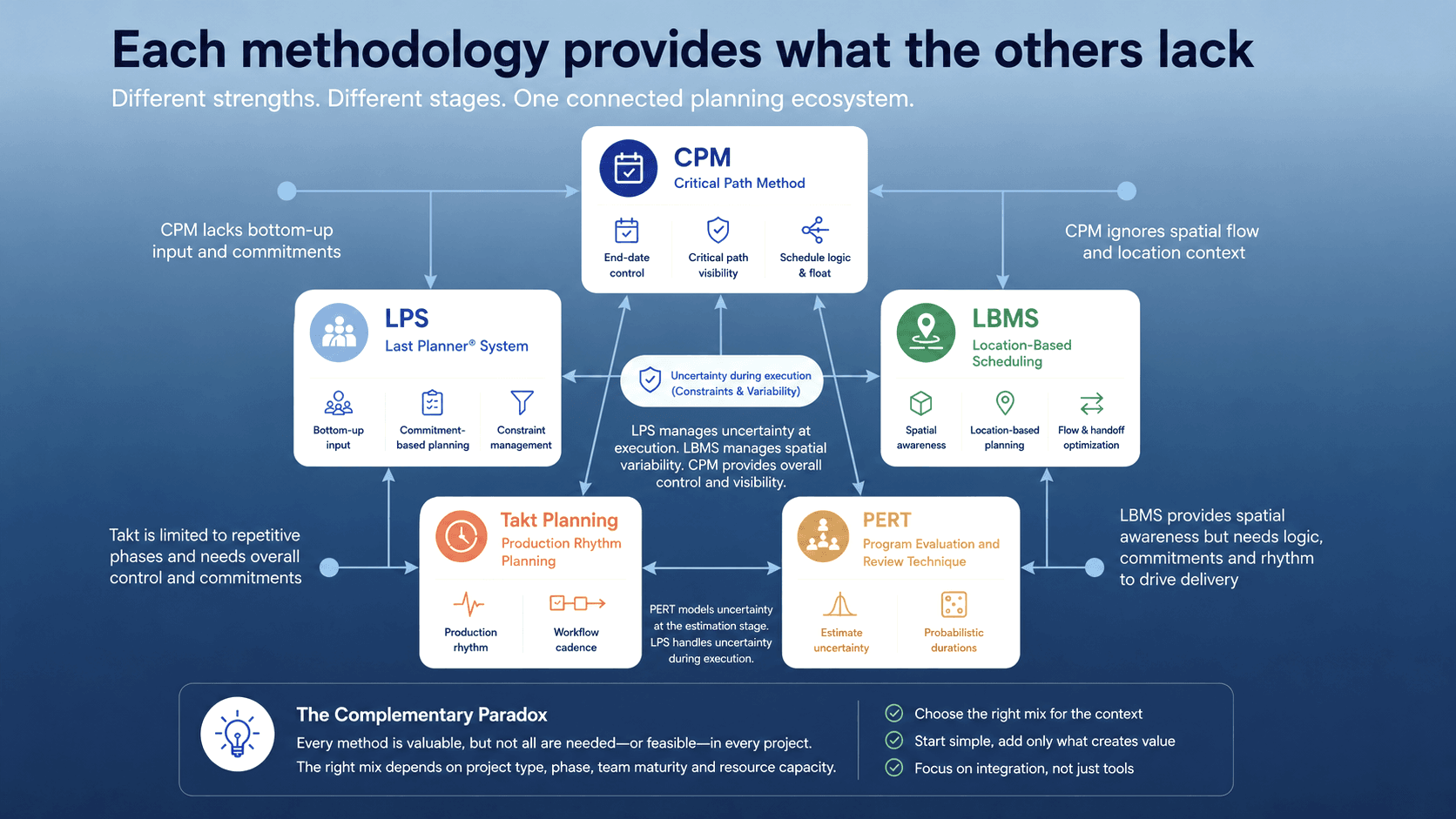
Each method's biggest limitation is precisely what another method compensates for:
- CPM lacks bottom-up input → LPS provides it
- LPS lacks end-date forecasting and critical path control → CPM provides it
- CPM ignores spatial flow → Location-based scheduling and Takt address it
- Takt is limited to repetitive phases → CPM and LPS handle the non-repetitive work
- PERT models uncertainty at the estimation stage → LPS constraint management handles uncertainty during execution
- Location-based scheduling provides spatial awareness → but needs CPM's logic, LPS's commitments, or Takt's rhythm to drive actual delivery
It's tempting to look at this and say: "Great — just use CPM and LPS together." Or "Combine Takt with CPM." But the truth is, it's very difficult to say which two are ideal in any given case. A data centre project might need CPM for the master programme, Takt for repetitive MEP fit-out phases, and LPS for weekly trade coordination — but barely use PERT or formal LBMS at all. A linear highway project might lean heavily on location-based scheduling and CPM but have no use for Takt. A first-of-a-kind research facility might start with PERT, shift to CPM, and layer LPS on top for execution — with no repetitive Takt phases in sight.
And then there's the practical question: can you really use all five methods simultaneously on a live project? In theory, they complement each other. In practice, most project teams have limited planning resources, a site team stretched thin, subcontractors who are already resistant to one new system — let alone five. Layering more methodologies onto a team that's struggling to maintain a single CPM programme can do more harm than good.
This is the paradox: every method is necessary, but not all of them are feasible in every context.
The External Factors Nobody Talks About Enough
Even if you could perfectly combine every planning methodology, the plan would still face forces that no scheduling technique fully accounts for:
Team skills and digital maturity. A methodology is only as effective as the team's ability to implement it. Introducing LPS to a team that has never done collaborative planning requires a cultural shift, not just a software rollout. Implementing Takt on a project where subcontractors have always worked to their own pace demands significant change management. If the team doesn't have the skills, confidence, or willingness to work within a method, the method will fail — regardless of how technically sound it is.
Site dynamics. Every site is different. A congested central London site with limited laydown areas, road closures, and live building operations creates planning pressures that a greenfield data centre campus in the countryside doesn't. The method that works beautifully on one site may be impractical on another. Planning approaches need to flex with the physical reality of the environment.
Project-specific context. A 50-storey residential tower with identical floor plates is a fundamentally different planning challenge from a hospital with bespoke clinical spaces on every floor. A refurbishment of a live airport terminal is nothing like a new-build logistics warehouse. The project's complexity, repetitiveness, stakeholder landscape, and delivery model all influence which planning approaches are viable.
Contractual obligations. This is the one that practitioners feel daily but rarely see in blog posts about planning methodologies. Many contracts require a CPM-based programme as a deliverable. Extension of time claims are assessed against CPM logic. Delay analysis uses critical path methodology. Even if the delivery team knows that Takt or LPS would improve execution, the contractual framework may demand CPM as the primary planning language — making everything else supplementary at best.
These external factors don't negate the planning methodologies — they shape which ones are appropriate, when they should be introduced, and how deeply they can be adopted on any given project.
So Where Does This Leave Us?
Here's the conclusion we've been building towards, and it might not be what you expected from a blog that started by listing planning methods.
There is no ideal method. There is no perfect combination. And there is no universal answer.
But that's not a pessimistic conclusion — it's a liberating one.
Because if there's no shortage of planning tools and techniques at our disposal (and there isn't — PERT, CPM, LBMS, LPS, and Takt are all mature, well-proven, and genuinely useful), then the bottleneck was never the methodology. The bottleneck is adaptability.
The projects that deliver reliably aren't the ones that picked the "right" method. They're the ones with teams that were dynamic enough in their approach and capable enough in their tooling to adapt to the evolving needs of the project — shifting from one technique to another as the situation demanded, combining methods where it made sense, and keeping them connected so that decisions at one planning level didn't create chaos at another.
This is fundamentally what VisiLean was designed to enable.
VisiLean: Not a Methodology — A System for Managing All of Them
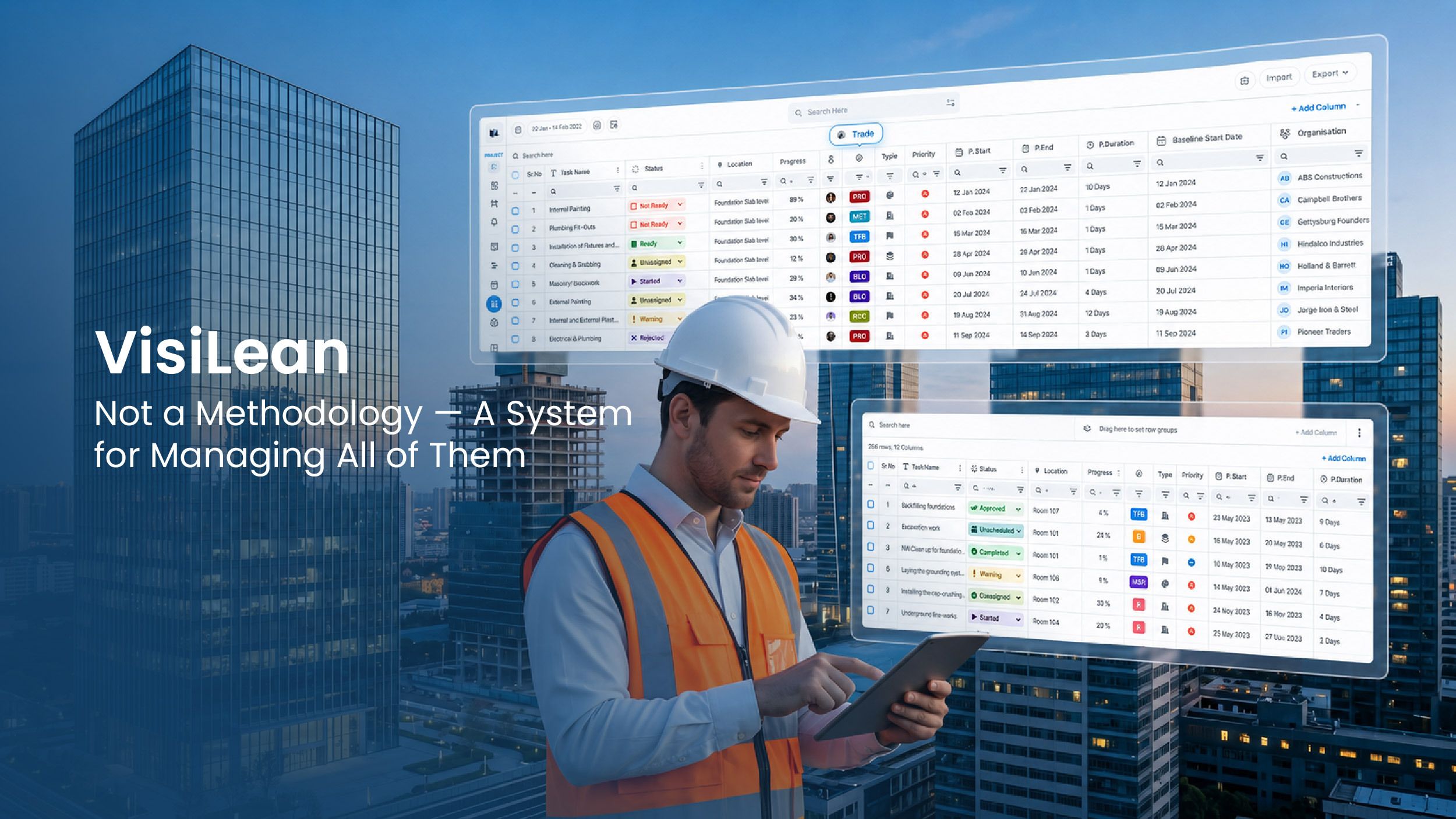
VisiLean doesn't force you into one planning approach. It doesn't assume your project is simple enough for a single method. Instead, it provides a single production management platform that supports CPM, LPS, Takt, and location-based planning — and keeps them connected so that your master programme, lookahead plans, weekly commitments, and site updates all speak the same language.
CPM as the backbone: Import your P6, MSP, or Asta schedules directly into VisiLean's Gantt View, or build them from scratch. Your critical path logic, dependencies, and milestones stay intact — giving you the top-down structure and contractual programme that your project demands.
LPS for execution: VisiLean's Collaborative Planning module layers bottom-up planning directly onto the CPM schedule. Trades participate in lookahead planning, constraints are mapped and tracked against tasks, and weekly commitments are made by the people doing the work. The gap between CPM's top-down logic and site reality closes because the plan now has both halves of the conversation.
Takt for production rhythm: Where your project has repetitive phases, VisiLean's Takt Planning module establishes flow-based scheduling with Wagons moving through Zones at a consistent beat. Pre-built Takt Templates accelerate setup and standardise repetitive sequences. And critically, Takt is synchronised with the CPM master schedule and LPS execution layer — so production rhythm doesn't drift from overall programme targets.
Location-based visibility throughout: Location swim-lanes in the Collaborative Planning view, VisiLean Maps for GIS-integrated spatial planning on linear and infrastructure projects, and 4D BIM visualisation that shows trade movement through the building over time — spatial awareness isn't a separate module; it's woven into every planning view.
Real-time execution through LiveSite: The LiveSite mobile app keeps everything connected to site reality. Progress updates, photos, constraint flags, delay reasons, and notes flow from the field into the central system in real-time — so the plan is always alive, always current, and always trustworthy.
Production control through dashboards: PPC tracking, reason-for-variance analysis, constraint summaries, Meeting Mode for structured weekly reviews, and auto-generated Daily Progress Reports — giving project managers the metrics to spot systemic issues, drive continuous improvement, and keep the overall programme on track even while managing weekly variability.
The point isn't that VisiLean has more features than other tools. The point is that it connects the planning levels — master programme, lookahead, weekly commitments, site execution, and production control — into a single continuous workflow. When the CPM schedule, the LPS commitments, the Takt rhythm, and the site updates all live in one system, the team can be genuinely adaptive without losing control.
Final Thoughts
There is no single ideal way to plan a construction project. The industry has tried for decades to find one, and the honest answer is that construction is too complex, too variable, and too dependent on context for any single technique to be enough.
But that's not the problem it seems to be. PERT, CPM, LBMS, LPS, Takt — the methodologies exist, they're proven, and each one solves a real problem. There is no shortage of planning tools at our disposal.
What determines success isn't the method you choose. It's your ability to be dynamic in your approach — to apply the right technique at the right phase, adapt as conditions change, and keep everything connected so that the plan remains a living reflection of reality rather than a frozen document from six weeks ago.
The teams that deliver reliably are the ones that can answer three questions at any moment:
- Where are we supposed to be? (CPM, milestones, critical path)
- Where are we actually? (Real-time site data, PPC, constraints)
- What do we need to do this week to stay on track? (LPS commitments, make-ready planning, Takt rhythm)
If your planning system can connect those three questions — from the boardroom to the site cabin to the engineer's phone — you don't need the "ideal" methodology. You have something better: the ability to adapt, respond, and control your project no matter what the site throws at you.
That's exactly the system VisiLean was built to be.
Book a demo with us for your project success!
Don't get left behind. Discover how VisiLean can enable your teams to be more efficient. Want to know more? Head to our YouTube channel, or visit our website to learn about all our features and book a demo with our team!