Lean construction is a modern project delivery philosophy that adapts the principles of Lean manufacturing to the construction industry. Its primary goals are to reduce project duration and cost while simultaneously increasing quality and safety. To achieve this, Lean construction utilises specific
Lean construction is a modern project delivery philosophy that adapts the principles of Lean manufacturing to the construction industry.
Its primary goals are to reduce project duration and cost while simultaneously increasing quality and safety. To achieve this, Lean construction utilises specific methods, including significantly improving planning processes, increasing transparency across the project, and actively fostering stronger collaboration among all stakeholders
This approach fundamentally differs from traditional construction by emphasising extensive upfront planning, prioritising collaboration from the project's inception, and focusing on proactive problem prevention rather than reactive problem-solving. Read on to know more about how Lean construction achieves these transformative results.
Lean Construction Principles
The Lean philosophy creates a living system focused on maximising value for the customer in the final output by optimising the production system for efficiency and systematically minimising waste from the process. Here are the core principles that give a clear direction to this methodology:

1. Define Value from the Customer’s Perspective
Value is defined by what the client truly needs, not by assumptions. Lean ensures every activity contributes directly to customer value, typically by clearly defining project requirements, desired outcomes, and key performance indicators (KPIs) from the very beginning. This customer-centric view drives every subsequent decision and ensures the final product meets the end-user's needs.
2. Eliminate Waste
Waste includes delays, rework, excess inventory, unnecessary movement, overprocessing, and unused human potential. Lean actively identifies and removes these inefficiencies, often categorised using the 'Eight Wastes' (Defects, Overproduction, Waiting, Non-Utilised Talent, Transportation, Inventory, Motion, Extra-Processing – DOWNTIME). Systematic waste reduction frees up resources, shortens project schedules, and reduces costs.
3. Improve Flow
Work should move smoothly from one task to the next without interruptions, bottlenecks, or waiting times. Lean achieves this by breaking the project into smaller, manageable batches, using pull systems (like Kanban) to ensure work is ready just as it is needed, and geographically clustering related trades to maintain a continuous, uninterrupted workflow. The goal is a steady, predictable pace of work.
4. Increase Reliability
Lean focuses on making plans that can actually be executed. Reliable commitments are more important than aggressive schedules. This is primarily achieved through the Last Planner System® (LPS), which fosters a culture where teams only commit to work they are certain they can complete, leading to more predictable outcomes and a higher Percentage of Plan Complete (PPC).
5. Pursue Perfection (Continuous Improvement)
Lean is not a one-time fix but a continuous journey toward perfection. This principle encourages a culture of constant learning and iterative improvement (Kaizen). Teams regularly review processes, identify root causes of problems, and implement small, incremental changes to enhance efficiency, quality, and value delivery over the life of the project and in future projects. This commitment to ongoing refinement is what sustains the Lean system.
6. Respect for People
People closest to the work are best positioned to plan it. Lean empowers teams to collaborate, make commitments, and solve problems together. This respect is demonstrated by investing in workforce training, involving trades in the design and planning phases (Early Contractor Involvement), and creating a safe environment where frontline workers are encouraged to identify and propose solutions to problems.
7. Continuous Improvement
Lean is not a one-time change. Teams regularly reflect, learn, and improve processes throughout the project lifecycle. This involves frequent, structured reflection meetings (such as Plus/Delta or After Action Reviews) after work phases to capture lessons learned and immediately apply process improvements to subsequent phases of the project.
How Lean Construction Works
Lean Construction works by transforming how projects are planned, coordinated, and executed.
Instead of top-down scheduling, Lean uses collaborative planning, where all stakeholders—designers, contractors, subcontractors, and suppliers—participate in defining the work sequence. Plans are broken into manageable, reliable tasks that teams commit to delivering.
Performance is measured not just by progress but by plan reliability, learning from failures, and improving future commitments.
At its core, Lean Construction treats construction as a production system, not a collection of isolated activities.
Lean Construction Planning Tools
Lean Construction planning is fundamentally collaborative, commitment-driven, and continuous. Rather than treating planning as a one-time scheduling exercise, Lean views it as an integrated system that connects long-term intent with day-to-day execution while continuously learning and improving.
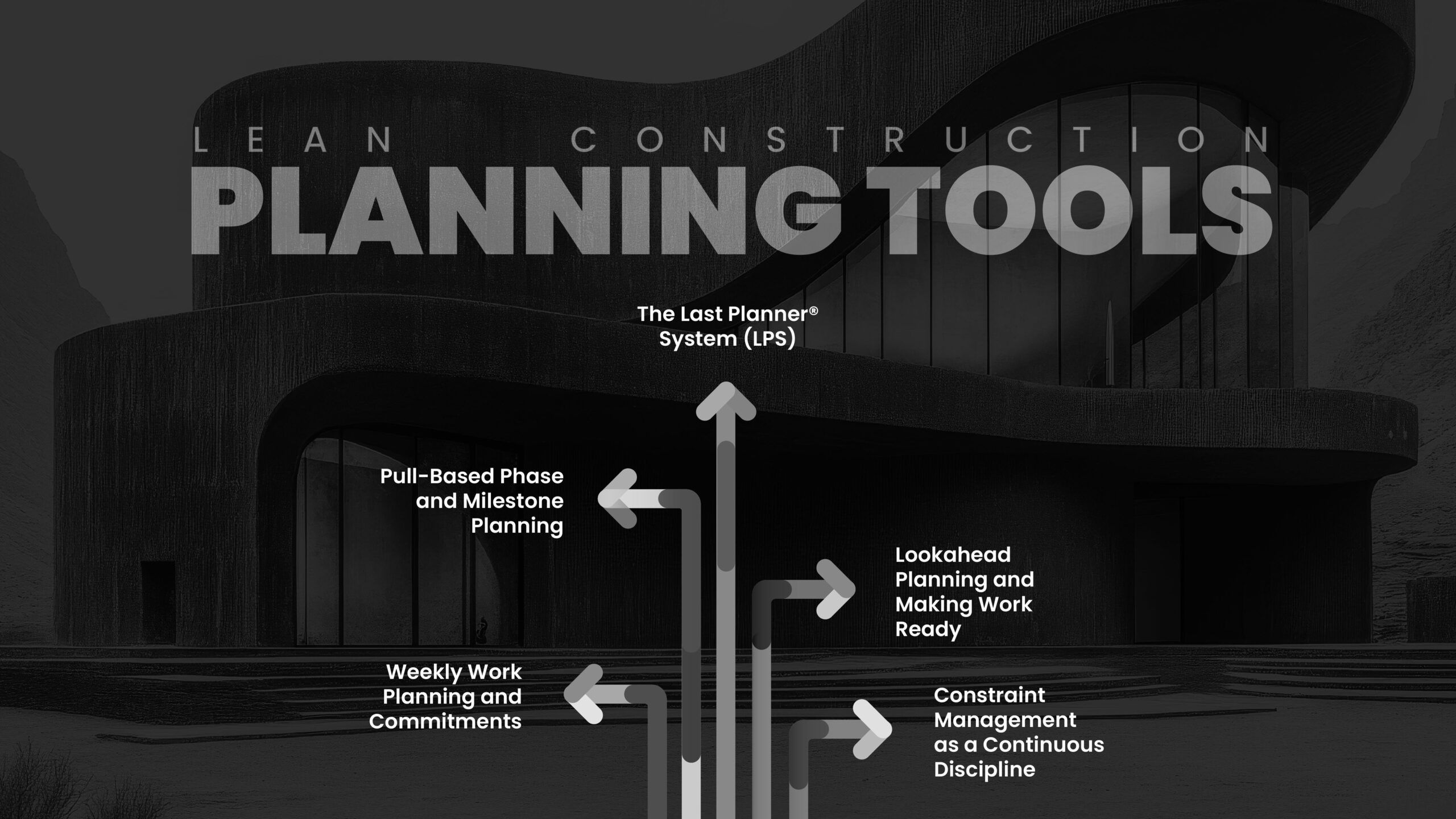
At the heart of this system is the Last Planner® System (LPS), within which several planning components work together to improve coordination, reduce variability, and increase the reliability of work on site. These components are not independent tools; they form a structured planning and control cycle that enables predictable project delivery.
The Last Planner® System (LPS)
The Last Planner® System provides the overarching framework for Lean Construction planning. It shifts planning from prediction-based schedules created by a few individuals to commitment-based planning developed collaboratively by those closest to the work.
Within LPS, “last planners” such as site engineers, foremen, and supervisors actively participate in defining what can be done and committing to what will be done, based on real site conditions and constraints. The system emphasises making work ready before it is committed, measuring plan reliability through metrics such as Percentage of Plan Complete (PPC), and learning from reasons for non-completion to continuously improve future planning cycles.
Pull-Based Phase and Milestone Planning
Lean planning begins by clearly defining project milestones and phase objectives, then working backwards to establish the sequence of work required to achieve them. This pull-based approach makes dependencies explicit, clarifies handovers between trades, and exposes gaps that are often hidden in traditional forward-planned schedules.
By aligning the plan with how work must actually flow through the site, pull-based planning improves coordination, strengthens trade alignment, and creates a more stable foundation for downstream execution.
Lookahead Planning and Making Work Ready
Lookahead Planning operates within the LPS framework to bridge the gap between high-level phase plans and short-term execution. It focuses on the upcoming weeks of work and systematically evaluates whether planned tasks are ready to be performed.
This process identifies and addresses constraints such as incomplete designs, delayed materials, pending approvals, access limitations, or unresolved coordination issues early enough to prevent disruption on site. The objective is not to reshuffle work reactively, but to increase the readiness and reliability of planned tasks before they are released for execution.
Weekly Work Planning and Commitments
Weekly Work Planning translates readiness into action. Based on what has been made ready through lookahead planning, teams collaboratively commit to a set of specific, achievable tasks for the coming week.
These commitments are grounded in actual site conditions, available resources, and agreed dependencies. Performance is reviewed regularly, reinforcing accountability and enabling teams to assess how reliably plans are being delivered. Over time, this creates a stable rhythm of work and significantly reduces the gap between planned and actual progress.
Constraint Management as a Continuous Discipline
Constraint management underpins all Lean planning activities. It involves the systematic identification, tracking, and removal of anything that prevents work from being executed as planned, whether related to information, materials, decisions, or coordination.
Rather than responding to problems once work stops, Lean planning addresses constraints proactively as part of the planning cycle itself. This protects workflow, maintains momentum across trades, and enables teams to focus on execution rather than firefighting.
Together, these planning components form an integrated Lean Construction planning system, enabling teams to move from reactive scheduling to reliable, collaborative, and learning-driven project control.
Benefits of Lean Construction
Adopting Lean Construction delivers measurable, repeatable benefits by improving how work flows through a project, not by pushing teams to work harder. The focus is on reducing variability, improving coordination, and strengthening planning reliability.
1. Reduced project delays and cost overruns
Lean projects experience fewer delays because risks and constraints are identified before work reaches the site, not after progress stalls. By making work ready and sequencing activities realistically, teams avoid the cascading delays and cost overruns that typically result from last-minute changes, rework, and reactive firefighting.
2. Improved productivity and workflow stability
Productivity improves when crews can work without interruptions. Lean stabilises workflow by ensuring tasks are properly prepared, resources are available, and handovers between trades are clear. This reduces stop–start work, idle time, and inefficient task switching, leading to more consistent daily output.
3. Less rework and fewer defects
Many defects occur when work starts based on assumptions, missing drawings, incomplete information, or unresolved coordination issues. Lean reduces rework by emphasising readiness checks and clear commitments, ensuring tasks begin only when conditions are right. Problems are prevented rather than corrected later at a higher cost.
4. Better collaboration and team morale
Lean planning creates a shared understanding of goals, constraints, and responsibilities. When teams are involved in planning and decision-making, trust improves, blame culture reduces, and coordination becomes proactive. This leads to higher morale, stronger ownership of commitments, and better cross-trade collaboration.
5. Increased transparency and predictability
Lean makes plans, constraints, and progress visible and explicit. Instead of relying on assumptions or informal updates, teams gain a clear picture of what is planned, what is ready, what is blocked, and why. This transparency improves predictability and enables faster, better-informed decisions.
6. Higher client satisfaction
Clients benefit from Lean through more reliable delivery, clearer communication, and fewer surprises. Predictable progress, reduced claims, and improved quality outcomes translate into stronger confidence and long-term relationships.
7. Safer job sites through better planning
Safety improves when work is properly planned and coordinated. Lean reduces unsafe conditions caused by congestion, rushed activities, and unplanned trade overlaps. By stabilising workflow and clarifying responsibilities, teams can plan work in a safer, more controlled manner.
8. Proactive problem-solving instead of firefighting
Lean projects consistently outperform traditional projects because issues are surfaced early and systematically, not discovered when work fails on site. By learning from breakdowns and improving plans, teams move from reactive problem-solving to continuous improvement.
Lean Construction vs Traditional Construction
The fundamental differences between traditional construction approaches and Lean Construction are evident in several key areas: planning methodology, on-site work coordination, the process for identifying and resolving problems, and the methods used for performance measurement. This distinction is crucial because Lean Construction is specifically designed to deliver more reliable and predictable project outcomes, overcoming the limitations inherent in traditional, purely schedule-driven methods.
Traditional Construction
Traditional construction relies on top-down planning and fixed schedules created early in the project. These plans are often developed away from the site and assume stable conditions. When design changes, delays, or coordination issues arise, problems are handled reactively, after work is already disrupted.
Execution focuses on individual task completion and reporting, rather than on whether downstream work is truly ready. Trades work in silos; workflows are fragmented, and learning is usually limited to end-of-project reviews—too late to improve outcomes.
Lean Construction
Lean Construction treats construction as a production system, not a set of isolated tasks. Planning is collaborative and continuous, involving those closest to the work so plans reflect real site conditions and constraints.
Work is released only when it is ready, with clear dependencies and commitments in place. Performance is measured by plan reliability and learning, not just progress. Issues are identified early, addressed proactively, and used to improve future planning, leading to more predictable delivery, less rework, and better coordination.
Role of Technology in Lean Construction
Digital tools are essential for enabling Lean Construction at scale because Lean outcomes depend on accurate, timely, and well-integrated information flows. Building Information Modelling (BIM) strengthens Lean delivery by acting as a reliable information backbone for planning, coordination, and execution. Beyond 3D visualisation, the role of BIM and Software in Lean construction is to support coordinated design reviews, clash detection, and sequencing, helping teams identify conflicts and inefficiencies long before work reaches site. When BIM is intentionally integrated with Lean planning routines, it aligns design intent with construction execution, improves workflow reliability, and reduces rework. Lean-focused digital platforms build on this foundation by enabling real-time collaboration, visual management of workflows, progress tracking against commitments, and early identification of constraints. Together, BIM and Lean-supported digital tools shift projects from reactive problem-solving to proactive control, enabling continuous learning, predictable delivery, and sustained improvement across the project lifecycle.
Final Thoughts
Lean Construction represents a fundamental shift in how construction projects are delivered. By focusing on flow, reliability, collaboration, and continuous improvement, Lean transforms construction from a reactive industry into a predictable, value-driven production system.
As projects grow more complex, Lean Construction is no longer optional; it’s essential. This is where Construction Simplified becomes more than a philosophy, and VisiLean becomes the enabler, translating Lean principles into everyday planning, coordination, and execution on site. By connecting people, processes, and real-time data, VisiLean helps teams reduce waste, improve reliability, and consistently deliver better project outcomes.
FAQs on Lean Construction
Is Lean Construction only for large projects?
No. Lean principles can be applied to projects of any size, from small renovations to large infrastructure developments.
Does Lean Construction increase planning effort?
Yes, but strategically. More effort is invested upfront to reduce delays, rework, and firefighting later.
Can Lean work without software?
Yes. Lean is a mindset first. However, software significantly enhances visibility, coordination, and scalability.
How long does it take to see results?
Teams often see improvements in reliability and collaboration within weeks, with major performance gains over the project lifecycle.