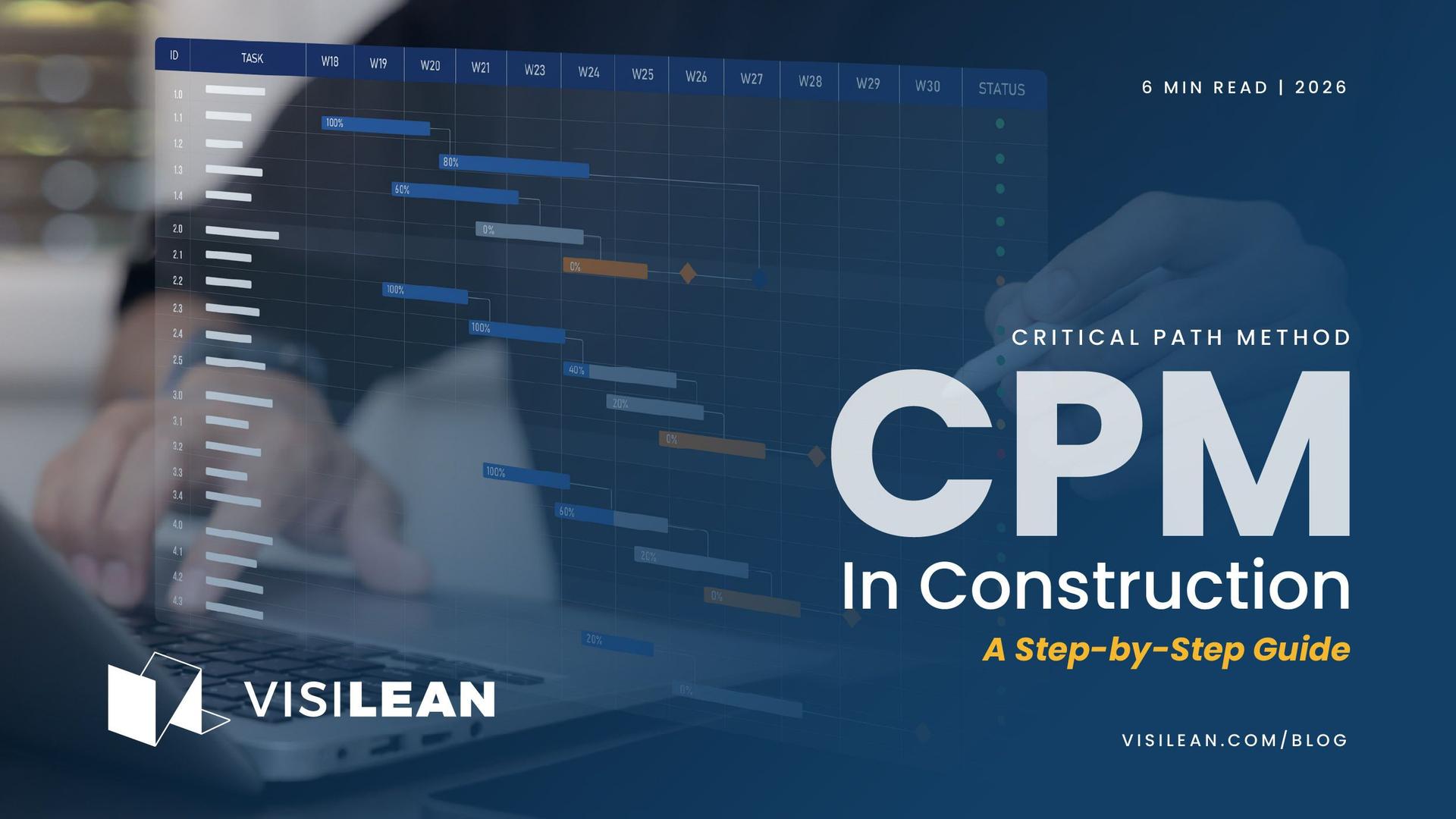
The critical path method (CPM) is a scheduling technique that finds the longest chain of dependent activities in a project. That chain, the critical path, sets the shortest time the project can finish, because delaying any activity on it delays the whole project.
Every construction schedule has one sequence of tasks that controls the finish date. Speed up a task that is not on it and you gain nothing. Delay a task that is on it and the whole project slips. The critical path method is how you find that sequence, protect it, and know where you actually have room to move.
This guide explains what CPM is, the key terms, how to calculate the critical path step by step with a worked construction example, how CPM compares to PERT, and where it fits alongside modern lean planning.
What is the critical path method (CPM)?
The critical path method is a project scheduling technique that models all the activities in a project, their durations, and their dependencies, then identifies the longest path through them. That longest path is the critical path, and its length is the shortest possible duration of the project.
The insight is simple but powerful: not all tasks are equal. Some have spare time, or float. The ones with none are critical, and they are where a planner's attention belongs.
Key CPM terms you need to know
- Activity. A task with a duration, for example "pour foundations".
- Dependency. A relationship where one activity must follow another, for example excavation before foundations.
- Duration. How long an activity takes.
- Early start / early finish (ES/EF). The soonest an activity can start and finish, found by working forward through the network.
- Late start / late finish (LS/LF). The latest an activity can start and finish without delaying the project, found by working backward.
- Float (slack). The spare time an activity has: LS minus ES. Zero float means the activity is critical.
- Critical path. The chain of zero-float activities that determines the project duration.
How to calculate the critical path, step by step
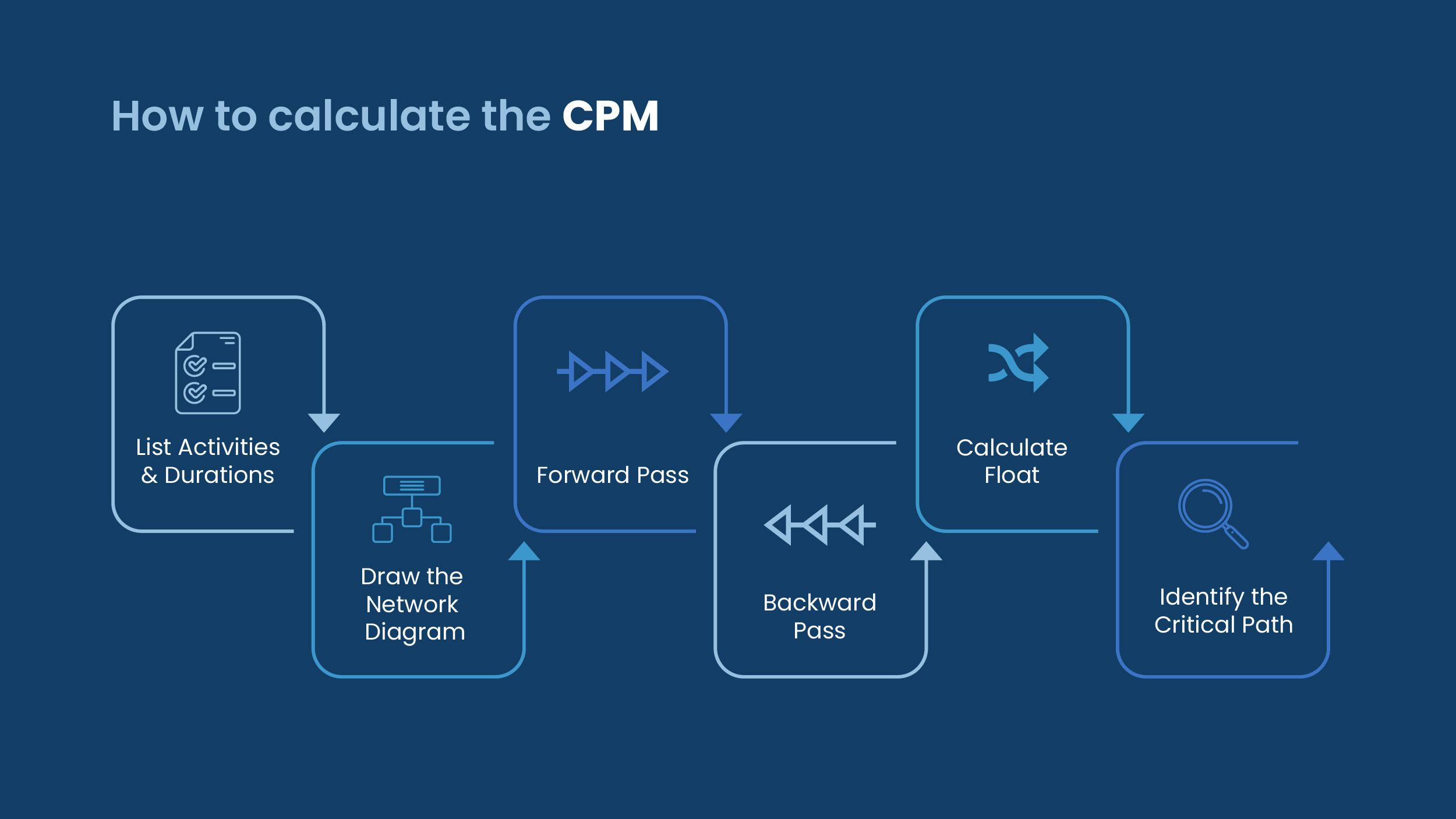
- List every activity, its duration, and its dependencies.
- Draw the network diagram showing the sequence and dependencies.
- Forward pass: work left to right to calculate each activity's early start and early finish.
- Backward pass: work right to left to calculate each activity's late start and late finish.
- Calculate float for each activity (LS minus ES).
- Identify the critical path: the connected chain of activities with zero float.
Worked construction example
Take a simplified early-works sequence:
| Activity | Description | Duration (days) | Depends on | Type |
|---|---|---|---|---|
| A | Site setup | 2 | – | Critical |
| B | Excavation | 4 | A | Critical |
| C | Foundations | 6 | B | Critical |
| D | Site fencing | 3 | A | Float |
| E | Superstructure | 8 | C | Critical |
Activities A, B, C, and E form a continuous chain of dependencies with no spare time: 2 + 4 + 6 + 8 = 20 days. That chain is the critical path, and 20 days is the shortest the project can finish. Activity D (site fencing, 3 days) branches off A but is not needed for the next steps, so it has float and can move within limits without affecting the finish. Delay B, C, or E by a day and the whole project slips a day. Delay D by a day and nothing changes, up to its float.
Doing this by hand is fine for five activities. On a real project of hundreds, the critical path is recalculated by scheduling software. In VisiLean, the plan is built as a connected schedule, so as durations and dependencies change the critical path updates automatically and stays visible to everyone, rather than being a one-off hand calculation that is out of date by the next site meeting.
CPM vs PERT
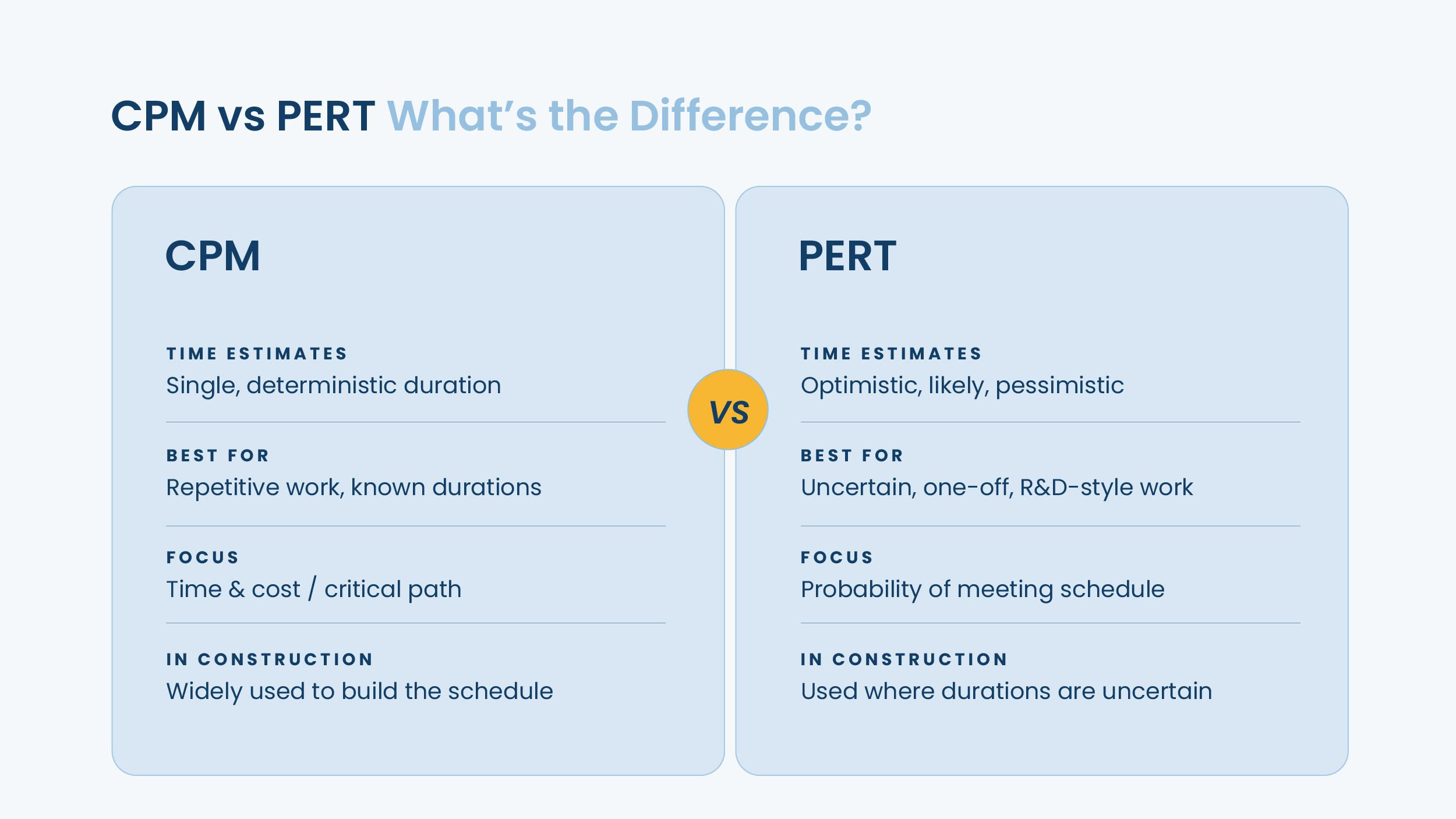
CPM is often mentioned alongside PERT. They are related but solve different problems:
| CPM | PERT | |
|---|---|---|
| Time estimates | Single, deterministic duration | Three estimates (optimistic, likely, pessimistic) |
| Best for | Repetitive work with known durations | Uncertain, one-off, R&D-style work |
| Focus | Time and cost / critical path | Probability of meeting the schedule |
| In construction | Widely used for planning the schedule | Used where durations are uncertain |
In construction, CPM is the workhorse for building and validating the schedule, while PERT thinking is useful where durations are genuinely uncertain.
CPM in construction: strengths and limits
CPM is excellent for setting the master schedule, understanding total duration, and seeing which activities carry risk. Its limitation is that it is a top-down, relatively static model. It assumes durations and logic hold, and it says little about the daily constraints, material readiness, and crew availability that actually decide whether today's work happens. That is why a CPM schedule can look healthy while the site stalls.
How CPM works with modern lean planning
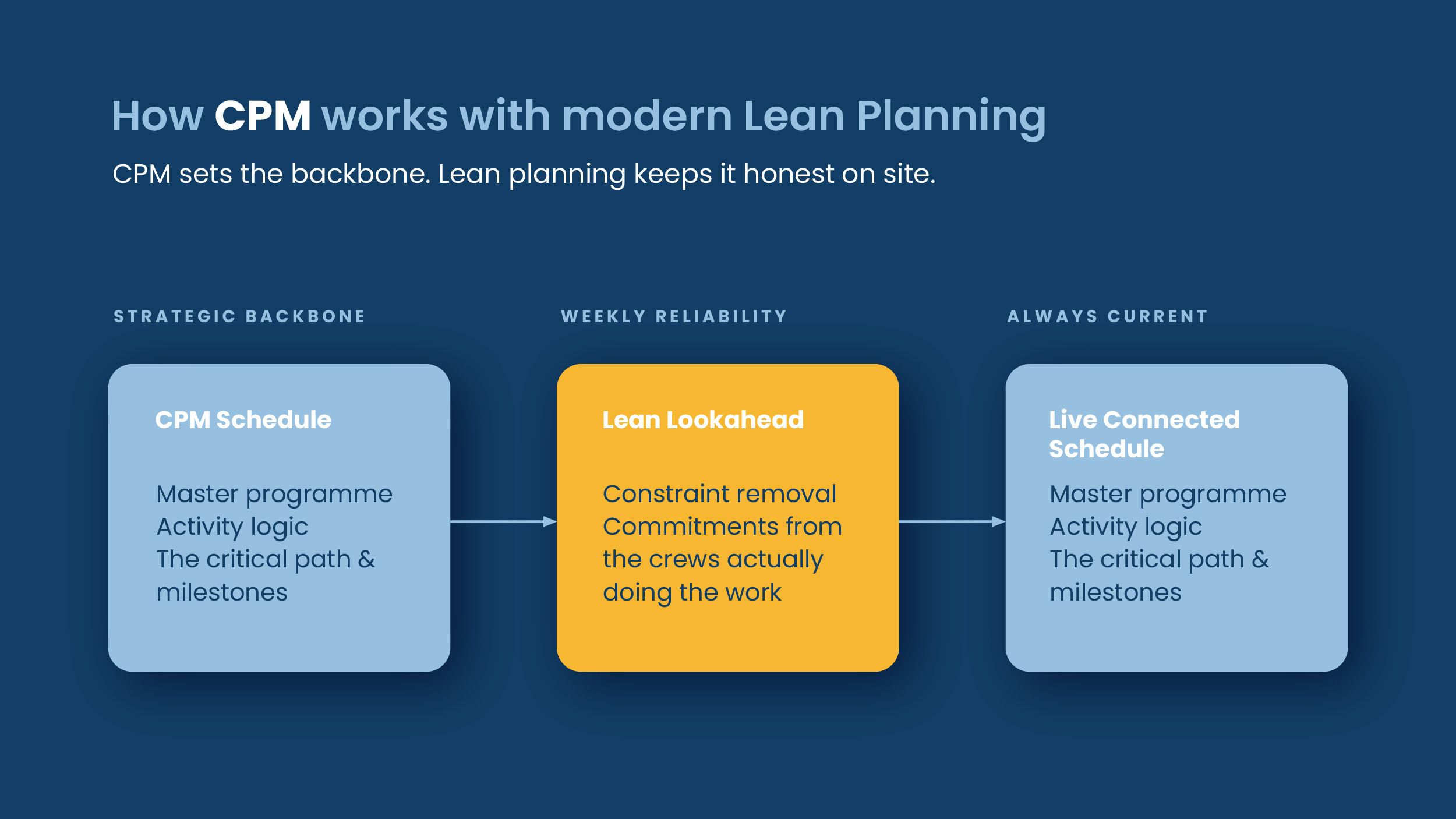
The strongest construction planning today pairs the structure of CPM with the reliability focus of the Last Planner System. CPM sets the backbone: the critical path and the milestones. Lean look-ahead planning then removes the constraints that would otherwise break that plan week to week, and tracks how reliably commitments are met. (We cover why CPM alone falls short, and how LPS complements it, in our post on construction project planning with LPS and CPM.)
This is exactly what VisiLean is built for. VisiLean connects the CPM schedule, the Last Planner look-ahead, constraint management, and live progress from the site in one system, so the critical path is not drawn once and forgotten but stays honest against what is actually happening. That is the difference between a schedule on paper and a schedule you can actually run a project from.
See how VisiLean keeps your schedule and critical path live. Explore planning and scheduling in VisiLean
Frequently asked questions
What is the critical path method (CPM)?
The critical path method is a scheduling technique that identifies the longest sequence of dependent activities in a project. That sequence, the critical path, determines the shortest possible project duration, because any delay to an activity on it delays the whole project.
What is the critical path in a project?
The critical path is the chain of activities with zero float, meaning none of them can slip without pushing out the finish date. Activities off the critical path have float, or spare time, and can move within limits without affecting completion.
What is float or slack in CPM?
Float, also called slack, is the amount of time an activity can be delayed without delaying the project. Activities on the critical path have zero float. Float is calculated from the difference between an activity's latest and earliest start (or finish) times.
What is the difference between CPM and PERT?
CPM uses a single, known duration for each activity and focuses on time and cost. PERT uses three time estimates to handle uncertainty and focuses on the probability of finishing on time. CPM suits repetitive work with predictable durations; PERT suits uncertain, one-off work.
Is the critical path method still used in construction?
Yes. CPM remains a standard for building and validating construction schedules. In modern lean delivery it is increasingly paired with methods like the Last Planner System, which manage the day-to-day variability and constraints that a static CPM schedule does not capture.