Restoring Planning as a Discipline: The Next Step Forward in Construction Project Delivery
Planning and Scheduling: Two Disciplines Worth Distinguishing
Construction planning is one of the most valuable disciplines on any project — and one of the most rewarding to do well. At its heart, planning is about understanding how workflows, identifying the conditions that allow tasks to start reliably, and anticipating the variability that shapes execution on site.
Scheduling is closely related, but distinct. It sequences activities, assigns durations, and defines dependencies. A schedule produces a clear timeline — and that timeline is a vital input into the planning process.
Over the years, scheduling and planning have sometimes been treated as the same activity. The Critical Path Method (CPM), one of the most widely adopted approaches in construction, has played a central role in shaping how we think about time on projects. CPM remains an excellent tool for analysing sequences and timelines, and it continues to provide essential structure to programme management.
What CPM was never designed to do, however, is manage how work is executed day-to-day on site. As Koskela (2014) observed, CPM is strong at modelling logical dependencies but was not built to maintain a stable workflow between project participants — a capability that complements, rather than competes with, the value CPM provides.
This blog explores how the relationship between planning and scheduling has evolved, the opportunities that come from treating planning as its own discipline, and the practical steps teams can take to strengthen it.
How the Planning Conversation Has Evolved
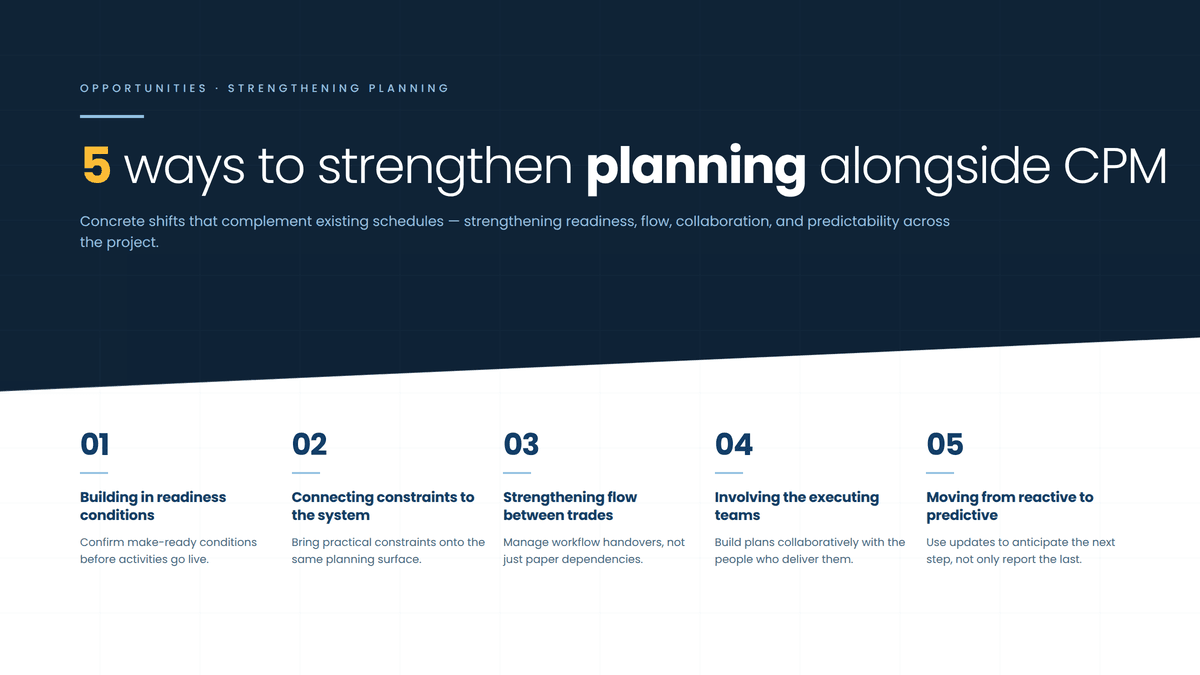
Over time, construction planning has become increasingly centred on time-management tools, most notably CPM. This has delivered enormous value — but it has also created opportunities to enrich planning with capabilities that sit alongside the schedule. Researchers and practitioners have identified several areas where planning can be strengthened:
1. Building in Readiness Conditions Alongside Activity Logic
CPM logic assumes that the completion of a predecessor activity is sufficient for the successor to begin. In practice, several additional conditions usually need to be in place — information, materials, access, prerequisite inspections — before work can reliably start.
These make-ready conditions are typically managed outside the CPM schedule. Bringing them into the planning conversation gives teams a clearer picture of when work is genuinely ready to begin.
2. Connecting Constraints to the Planning System
Practical constraints that determine whether work can proceed are often tracked in registers or systems that operate independently of the schedule. Linking these constraints to the readiness status of planned activities means issues can be surfaced and resolved early, rather than emerging at the point of intended commencement.
3. Strengthening Workflow Stability Between Trades
Construction work is highly interdependent. When one trade is delayed, the trades that follow feel the impact. CPM does an excellent job of mapping these dependencies, and there is real opportunity to build on that strength by paying equal attention to how work flows from trade to trade on site.
Koskela (2014) highlights this complementary need: dependable workflow between teams is essential to efficient site execution, and is best managed by planning practices that work in tandem with the schedule.
4. Involving the Teams Who Execute the Work
CPM schedules are typically developed during pre-construction by planning or project managers. Their technical quality is high, and they provide an excellent foundation. The opportunity is to bring subcontractors and site supervisors into the planning conversation, so that their practical knowledge — coordination needs, preferred sequencing, resource realities, and site-specific risks — informs the plan from the outset. Plans developed collaboratively tend to be more reliable in practice.
5. Moving from Reactive Updates to Predictive Insight
Schedules are typically updated weekly or fortnightly by comparing planned progress with actual progress. This is useful — and it can be made even more useful when paired with shorter planning cycles that look ahead to upcoming work, surface constraints before they bite, and help teams steer the project rather than report on it.
The Productivity Opportunity in Better Production Planning
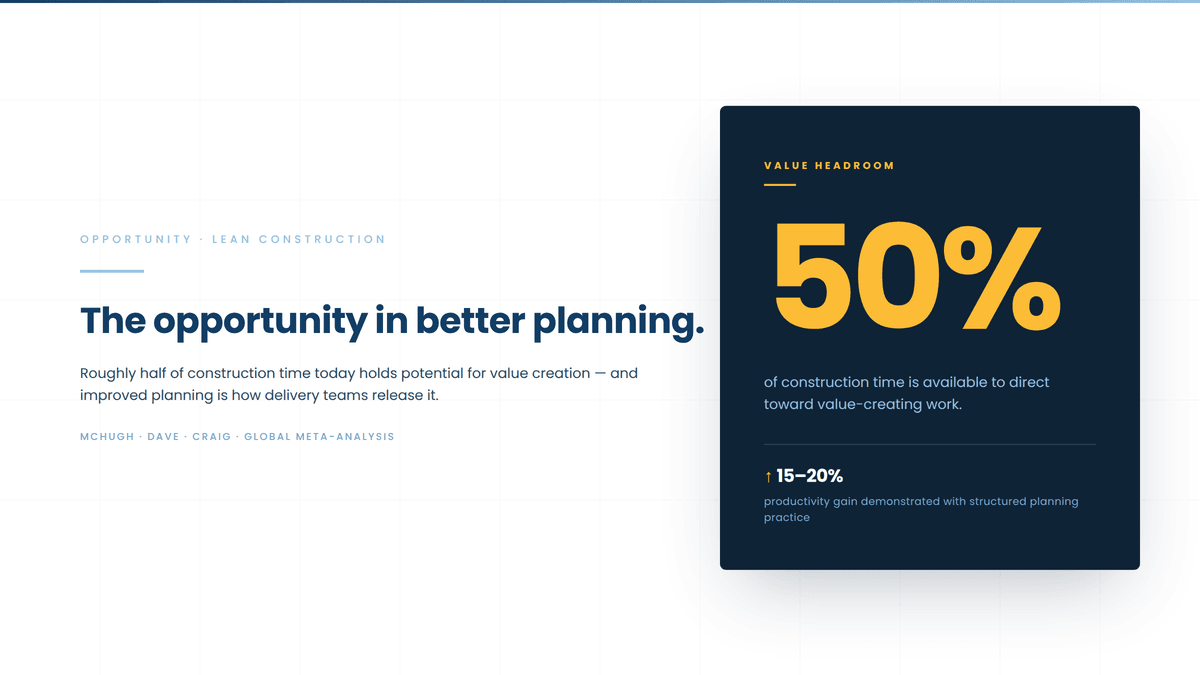
Stronger planning has a direct line to better productivity. The construction industry has long recognised that it operates below its potential, and the research points to meaningful headroom for improvement.
A meta-analysis cited by McHugh, Dave and Craig (2019) reports that, across global construction projects, around 49.6% of time is spent on non-value-adding activities. A parallel study in Sweden found that workers spend roughly 15 to 20 per cent of their time on direct productive work. These figures are not a reflection of workmanship or technology — they point to the value waiting to be unlocked by managing workflows, resolving constraints proactively, and planning in a way that reflects site reality.
Put simply: planning is one of the highest-leverage areas any construction organisation can invest in.
What Effective Construction Production Planning Looks Like
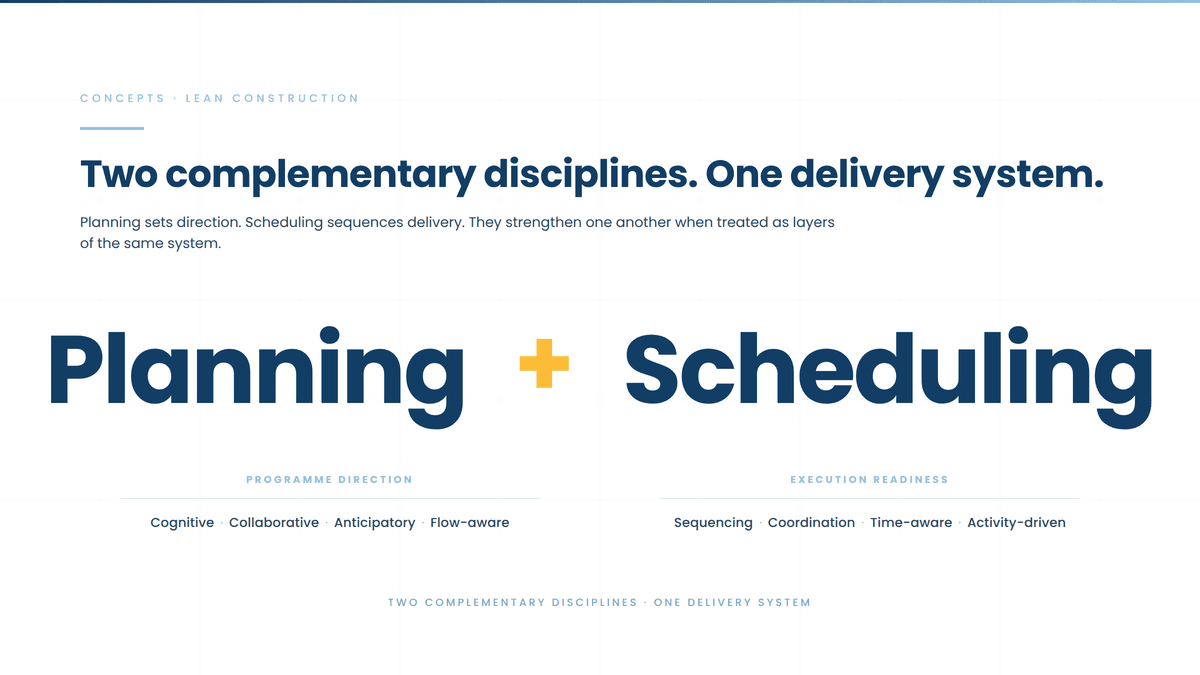
Planning, in its fullest sense, is a continuous management discipline. It draws on specific thinking capabilities, organisational conditions, and habits that complement — rather than replace — the scheduling tools teams already use. Strengthening planning starts with clarity about what the discipline involves.
1. Production Thinking: Understanding Work as a Flow System
Work moves forward on site when information arrives on time, materials are ready, and the incoming team has everything they need. Thinking about work as a flow — not just a sequence — gives planners a richer picture of how projects actually progress.
Koskela’s TFV framework captures this neatly, describing production across three dimensions: Transformation, Flow, and Value. CPM excels at the first; planning that consistently predicts site reality embraces all three, recognising that a start date carries more meaning when the conditions for starting are in place.
2. Human Judgement and Tacit Knowledge
Experienced planners bring deep understanding of site conditions, trade behaviours, supplier patterns, and team dynamics. This knowledge, built through years of direct engagement on projects, is what helps a plan predict reality rather than simply document intent.
When planning is treated as more than populating a tool, this expertise is actively used and continually developed. As McHugh, Egan and Dave (2025) note, learning thrives in environments that openly engage with what is and isn’t working — and the same is true of planning capability.
3. Organisational Conditions That Support Great Planning
Planning quality is shaped as much by the organisational environment as by the methodology applied. Three conditions matter most.
-
Trust — project teams must be able to share honest information about constraints and delays without fear of how it will be used. Where trust is absent, constraints are concealed until they become crises.
-
Psychological safety — people must feel genuinely able to raise problems and challenge assumptions. This is a cultural condition no platform can create. It is the difference between a planning meeting where real issues surface and one where everyone agrees everything is on track.
-
Commitment culture — when a team commits to a defined scope by a defined date, that commitment must mean something. As Ballard and Howell (2003) established, the reliability of planning commitments is measurable, and PPC only works where commitments are made with real intent. In organisations where missed commitments are simply rescheduled without examination, it becomes another number on a dashboard.
4. The PDCA Cycle as the Intellectual Backbone of Planning
In most projects, the gap between what was planned and what happened is managed through a schedule update, the baseline shifts and the project moves on. What rarely happens is asking why the gap occurred and what it reveals about planning reliability.
This is the essence of the Plan-Do-Check-Act cycle, which McHugh, Egan and Dave (2025) identify as the intellectual backbone of lean production management. Its power lies in the Check and Act stages, using execution data to understand planning quality and improve the next cycle. Most construction projects plan and do. Very few check and act in any meaningful sense, which is why the same causes of deviation recur project after project. Restoring this cycle, at every level from daily huddles to programme reviews, shifts planning from a document-production exercise into a genuine management discipline.
How VisiLean Supports Stronger Planning
Understanding what great planning involves is one part of the picture. Operationalising it consistently across complex, multi-trade projects is the next. Most organisations have the intent — what they often need is the infrastructure to connect planning thinking to daily site execution, and to feed execution data back into the planning process.
VisiLean was built to provide exactly that infrastructure. It complements the discipline of planning, supporting the human judgement and organisational conditions that planning requires, and giving teams an environment in which great planning practices can function at the scale that modern construction demands.
1. Connecting Strategic Scheduling to Production Planning
VisiLean brings CPM-based programme management together with production-level planning in a single environment. The master schedule stays connected to the lookahead, the weekly work plan, and the daily execution layer — so when conditions change on the ground, the response is informed and coordinated.
2. Collaborative Phase Planning and Pull Planning
Phase plans in VisiLean are developed collaboratively, with trade contractors and site teams working backwards from key milestones to define what must be in place at each preceding stage. This process surfaces coordination requirements and unrealistic assumptions before work begins, producing a plan grounded in the knowledge of the people who will execute it, rather than the assumptions of those who will not.
3. Lookahead Planning and Constraint Management
VisiLean’s lookahead planning function lets teams review upcoming activities across a 3 to 6 week horizon and systematically identify constraints — design releases, procurement gaps, inspection requirements, access issues — well before they would otherwise prevent work from starting. Constraints are tracked with ownership and resolution dates, turning the make-ready process into a structured planning function.
4. Weekly Work Planning and Daily Execution
Weekly work plans are developed directly from the phase plan and committed to when activities are genuinely ready to begin. Daily huddle functionality keeps the connection between planning and site reality strong, confirming progress, surfacing emerging constraints, and supporting smooth trade-to-trade handovers.
5. Performance Measurement and Continuous Improvement
VisiLean tracks PPC by trade, by zone, and by week, giving project leadership the data to understand planning reliability alongside execution performance. Deviations are spotted early, root causes are explored in coordination meetings, and improvements feed into the next planning cycle — the Check and Act steps of PDCA, operationalised at the project level.
6. Takt Planning for Production Flow
For projects with repetitive layouts — data centres, hospitals, residential towers, large interior fit-outs — VisiLean’s Takt planning capability coordinates trade movement through defined zones at fixed time intervals. This adds production rhythm and workflow stability that complement CPM, reducing congestion, eliminating waiting time, and making the site more predictable for every team on it.
7. BIM Integration
VisiLean connects the production plan to the 3D model, helping teams visualise work status spatially and spot coordination issues before they reach the site. This brings BIM into the production conversation as a live management resource, supporting the situational awareness that strong planning decisions rely on.
Conclusion — Strengthen Planning in Your Next Project
The best-performing construction projects are the ones where scheduling and planning each play their full role — where the programme provides direction, and planning ensures the conditions are in place to deliver on it.
Building that capability is rewarding work. It involves investing in planning thinking, nurturing the trust and commitment culture that reliable execution depends on, and establishing the learning cycles that make each project better than the last. With those conditions in place, technology becomes a powerful multiplier — and the results show on every site.
VisiLean brings these elements together, connecting programme management with production planning, enabling constraint resolution before delays occur, and providing the performance visibility that continuous improvement thrives on.
Book a demo with us today to see how VisiLean can transform your project.