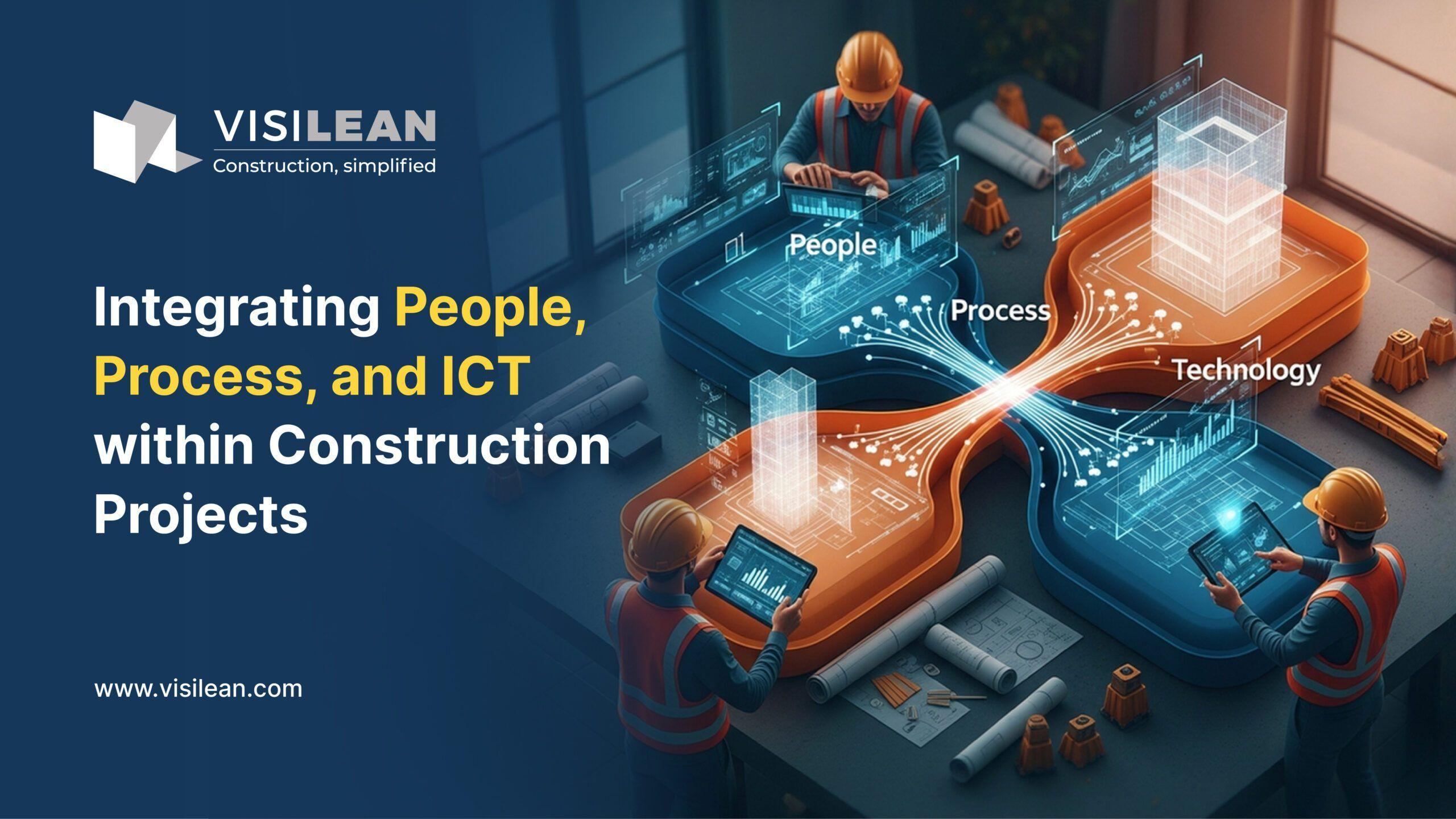
Despite years of research, innovation and adoption of construction technologies, the construction industry continues to face challenges like productivity and coordination. Technology alone cannot resolve fragmentation; ICT systems must be integrated with operational processes and the human systems that execute them.
Despite years of research, innovation and adoption of construction technologies, the construction industry continues to face challenges like productivity, coordination and more. Numerous initiatives have focused on deploying Information and Communication Technology (ICT) to address the challenges, still the results have often fallen short of expectations.
As argued in the seminal research by Dr. Bhargav Dave, Lauri Koskela, Mike Kagioglou, and Sven Bertelsen, technology alone cannot resolve the fragmentation inherent in construction. ICT systems must be purposefully integrated with both the operational processes that govern project delivery and the human systems that execute them. Simply put, technology must not operate in isolation but must act as a unifying infrastructure that enables better collaboration, decision-making and control.
This article builds on their framework to explore how the integration of people, process, and ICT forms the foundation for more effective construction project delivery. Moving ICT becomes an enabler of transformation only when aligned with the way people work and how construction processes are designed to flow.
Understanding the Three Pillars

The successful delivery of construction projects hinges not merely on technological advancement, but on the synergistic alignment of three foundational elements: People, Process, and Information and Communication Technology (ICT).
Each of these pillars contributes distinct value to a project’s lifecycle, yet in isolation, their impact remains limited. True performance gains emerge only when these elements are integrated into a unified operational framework.
People: The Central Agents of Coordination and Execution
People are the active agents who interpret data, make decisions, and execute tasks. Despite increasing digitisation, construction remains a highly collaborative and human-intensive industry.
However, this collaboration is frequently undermined by role-based silos, fragmented communication, and reactive decision-making. The lack of shared situational awareness and coordination across stakeholders often leads to rework, misaligned expectations, and schedule slippage.
Empowering people with real-time visibility, shared planning environments, and clear accountability is essential not just for task execution but for building trust and sustaining continuous improvement.
Process: The Operational Backbone of Project Delivery
Construction processes are inherently complex, involving dynamic interdependencies, variable conditions, and constant adjustments. These characteristics render traditional command-and-control approaches inadequate.
Without structured workflows and continuous feedback loops, teams struggle to maintain flow, manage constraints, or respond effectively to emerging issues. Process inefficiencies, often latent, are a key contributor to low productivity and high project risk.
Lean Construction offers a robust foundation for process thinking. By emphasising workflow reliability, constraint removal, and collaborative planning, Lean transforms construction from a fragmented activity into a managed flow of value. But process thinking must be embedded into everyday practice, not treated as a one-time intervention.
ICT: The Enabler, Not the End Goal
Information and Communication Technology (ICT) has become ubiquitous in modern construction, from Building Information Modelling (BIM) and scheduling software to mobile inspection tools and cloud-based dashboards. Yet, despite widespread adoption, project outcomes have remained stubbornly resistant to improvement.
This paradox arises because ICT is often deployed in a technology-first manner, without reconfiguring underlying processes or addressing the needs of the people expected to use these systems. The result is an array of disconnected tools that fail to support real-time decision-making or frontline collaboration.
For ICT to deliver meaningful impact, it must be:
- Intentionally aligned with process objectives,
- Seamlessly integrated into daily workflows, and
- Designed to enhance, rather than replace, human coordination.
Why Improving One Pillar without the Others Yields Limited Results?
In construction, isolated advancements, whether in tools, workflows, or workforce capabilities, are often met with diminishing returns when not supported by a broader systemic alignment. The reason lies in a fundamental truth: the pillars of People, Process, and ICT are interdependent, and gains in one domain cannot be fully realised unless reinforced by progress in the others.
Technology Without Process Alignment Leads to Fragmentation
A common misstep is deploying advanced technologies, such as BIM platforms, scheduling software, and mobile apps, without restructuring workflows or rethinking team collaboration. While these tools may enhance data capture or reporting, they often become isolated layers of digital documentation with minimal bearing on site-level decision-making.
Process Improvement Without Enabling Technology Limits Scalability
Conversely, process-focused efforts such as Lean Construction training, Last Planner workshops, or visual management boards can yield measurable improvements in reliability and coordination. However, in the absence of a scalable digital platform, such initiatives often struggle to sustain momentum beyond isolated teams or pilot projects.
Skilled People Without Systems Support Face Operational Friction
Construction teams are often staffed with capable professionals who possess deep domain expertise. Yet, when operating within fragmented systems, unclear workflows, siloed tools, and reactive planning environments, even the most skilled individuals face constant operational friction.
Analysing the Practical Implementation of an Integrated Model Through VisiLean

The integrated People-Process-ICT model described in the research demands that technology not be an isolated add-on, but a mechanism deeply embedded into the operational core of construction. VisiLean operationalises this principle by aligning process discipline, collaborative behaviours, and digital tools into a single production control environment.
Embedding Process Discipline Through Lean Control
VisiLean addresses this by embedding the Collaborative Planning System into its operational workflows. This enables teams to collaboratively define work sequences, identify and remove constraints before they cause delays, and measure workflow reliability to support continuous improvement.
Strengthening Communication and Trust
VisiLean operationalises the Language Action Theory framework by creating a shared environment where commitments are explicitly recorded, progress is visible to all, and updates occur in real time. This reduces ambiguity, increases accountability, and transforms ICT from a passive reporting tool into an active mechanism for coordinating action.
Integrating BIM and 4D Modelling into Execution
VisiLean bridges the disconnect between BIM and execution by linking model elements directly to live tasks and lookahead plans. This ensures that spatial and sequencing information from BIM and 4D models informs daily decision-making on-site.
Ensuring Flexibility Through Adaptive Architecture
VisiLean’s cloud-based, mobile-enabled platform, grounded in Service-Oriented Architecture (SOA) principles, addresses the rigidity of conventional ICT systems. Its modular design allows project workflows, reporting tools, and data sources to be integrated or adapted as conditions evolve.
Sustaining Improvements Across Projects
VisiLean mitigates the risk of pilot-only success by combining Lean-based process management with an integrated digital environment that enables lessons learned on one project to be measured, standardised, and applied to future projects.
Translating Research into Real-World Impact
The central message of the research is clear: lasting improvement in construction performance depends on deliberate integration of people, process, and ICT. Technology in isolation cannot overcome the deep-rooted fragmentation of the industry. Progress is achieved only when all three pillars operate in sync, reinforcing one another in daily project delivery.
VisiLean puts this principle into practice by providing a unified environment where Lean-based discipline, transparent communication, and adaptive digital tools converge.


